Photo: Pixabay Balkan Youth Deserve the Truth About the Past – Not DenialsSofija TodorovicBelgradeBIRNJune 30, 202317:51 Sofija TodorovicBelgradeBIRNJune 30, 202317:51A shrinking space for civic action and official hostility is preventing young people from seeking answers to questions they might have about past conflicts – but some young people are not ready to stay silent.
What is the truth and what authority is trustworthy to tell it? This is the question many young people struggle with when it comes to forming attitudes towards the bloody conflicts that followed the dissolution of Yugoslavia.
Societies in the countries most affected by the wars of the Nineties are still struggling with the legacy of those wars – which is not surprising. Many other post-conflict regions also struggle. This is a never-ending work, particularly taking into consideration what kind of harms and griefs wars leave behind.
Countries and societies face various challenges on their way to a stable peace and establishing a democracy based on democratic values and principles. Values such as truth, peace, anti-fascism and solidarity, as well as democracy, must be implemented into steps and actions aimed at building a future in which conflicts and wars are not a threat to our daily lives.
But the process of peacebuilding is never a straight line and is often slowed down by chauvinistic and nationalist narratives and actions coming from key politicians, state-controlled media and extremist groups.
Serbia is one of the countries that is a key to solving and addressing problems directly related to war and the past. Problems such as a shrinking civic and public space, media freedom, misuse of democratic procedures, lack of transparency and corruption have all become a part of its everyday life – and these challenges also jeopardize dealing with the past.
The struggle to keep streets free of hateful content
Last year, Youth Initiative for Human Rights YIHR organised a campaign led by the young in Serbia focused on mapping murals, graffities, stencils and other drawings on walls in Belgrade that glorify Ratko Mladic.
Mladić commanded the main staff of the Army of Republika Srpska, the Serb-led entity in Bosnia and Herzegovina during Bosnia’s 1992-95 war. He was sentenced to life imprisonment, as one of the leading men responsible for the 1995 genocide in Srebrenica, on June 8, 2021.
The fight for streets and walls free from hateful content whose role is to deny crimes such genocide and to celebrate those who have been convicted of genocide and war crimes intensified in 2021, when big mural dedicated to Mladic appeared in the Belgrade’s city centre in Njegoseva street.
A worrying fact is that the people engaged in patrolling this mural to prevent others from removing or destroying it were all young. The location of this mural was also registered on Google maps as a historical landmark, alongside a mural of Draza Mihailovic, a war criminal from the World War II worshiped by nationalists in Serbia.
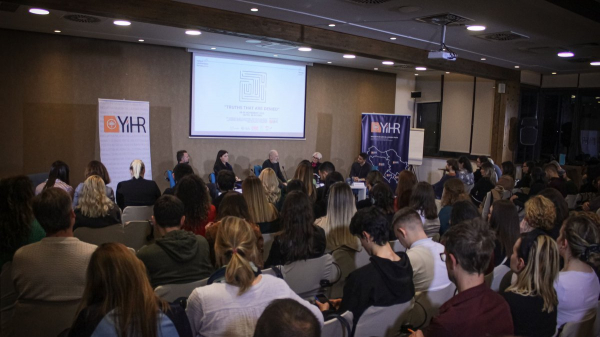
The regional conference “Truths That Are Denied”. Photo by YiHR
Gatherings planned to clean the wall have been banned by the Serbian authorities, and activists have been detained for throwing eggs at the wall. In December last year, the whole city of Belgrade was painted with the face and name of Mladic by hooligans without any reaction from the institutions.
At the start of 2023, YIHR sent more than 300 notifications to the competent local authorities in different cities in Serbia asking them to remove such drawings from the walls.
Only in one of the reported cases, in the municipality of Novi Beograd, did YIHR get positive feedback from the authorities that a stencil with Mladic’s face would be removed. Until now it didn’t happen. In another case, Palilula municipality responded confirming a mural at that location but without announcing any further steps.
The public space for actions and initiatives of groups of citizens that are dealing with the legacy of the past and hateful narratives in Serbia has been shrinking since 2012, so the need to intensify the work to protect public space has never been bigger. On the other side, however, people’s fear to tackle this topic in any manner is also rising.
Youth involvement has been maintaining dealing with the past process in Serbia in the last decade. Their energy, readiness and dedication has inspired many other young people to speak up, ensuring that the foundations for the reconciliation process are still there and can be achieved.
Turning the public space into a hostile zone
But the public space has slowly but surely became hostile for any action that doesn’t align with the Serbian government’s key political stands, regardless of guaranteed freedoms of assembly and other rights and freedoms.
For some activists, it has always been like this, but in the last ten years it only got worse. A regional aspect to all peace and conflict transformation activities remains essential, particularly because neighboring countries are still unable to work together on this.
Public commemorations represent both formal and informal ceremonies in memory of past events. As such, they form the basis from which collective memory is generated. Commemorative practices show us what a society remembers, what purpose that memory serves, as well as what it ignores and strives to forget.
In all countries, institutionally established commemorations and remembrance days are reserved for the largest ethnic group, and often these events in the mass media are followed with hostile rhetoric about “the other”, denial of crimes, and in some cases even glorification of convicted war criminals.
Functioning democracies depend on what is often called a culture of democracy – shared attitudes and behaviours, valuing diversity and conflict resolution through dialogue.
In November last year, more than 80 experts, diplomats, artists, journalists and academics from the region and more than 50 young people gathered in Belgrade for a conference called “Truths that Have Been Denied” to discuss the challenges posed to peace and reconciliation, the political landscape, the on-going crisis in the region, cooperation on various levels and education.
The results achieved would not have been possible without the support of BCSDN, Balkan Civil Society Development Network and SIDA, the Swedish International Development Agency.
At the conference, human rights and transitional justice experts shared experiences and recommendations for continued work on transitional justice and human rights work.
The conference gave young attendees practical knowledge and space to understand dealing with the past and reconciliation practices from a critical point of view. For some young people from Kosovo and Bosnia, it was their first time in Belgrade, so such gatherings are still vital for overcoming prejudice and fears and creating ties among people based on trust building and honest conversation, free from denial and relativisation of the past.
Regarding the situation in Kosovo, a major achievement of the conference was to bring young people together to meet each other, share perspectives and opinions, and network.
The future starts by knowing the past
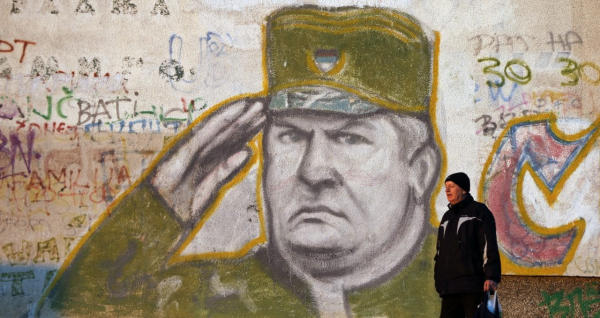
A man walks in front of a mural depicting Serbian General Ratko Mladic, EPA/KOCA SULEJMANOVIC
Many steps taken by governments across the region that have damaged dealing with the past have been taken under the excuse of safety and the future of “our people”.
Little do they realise that the future of citizens in the region, at least the one many of us hoped and fought for after the wars, begins precisely by obtaining knowledge about the past that enables a higher level of empathy and understanding. Or maybe they do know?
My own belief is all the political actors and state representatives know exactly what they do when they deny facts, celebrate war criminals, manipulate victims, antagonize their neighbors or minorities and obstruct the justice process. The reason is disappointingly simple and banal; if a prosperous and thriving future starts by knowing the past, in that kind of future they will be left without power, or even held accountable for their actions.
A set of recommendations has been published in the form of a Manual for the improvement of commemorative practices and the fight against the glorification of war criminals. It’s clear what needs to change and what needs to be done.
The younger generation deserves not to fight old battles that have ended and that they didn’t participate in. So their voice is crucial for the defence of their own future – if they still see it here.
We can discuss the impact of many things about dealing with the past and explore layers of this process; but the only thing that all states have invested a lot in so far is to hamper those young people who still resist dominant narratives and historical revisionism.
By using basic logic and analyzing the context in which they are being raised, educated and informed, these young people – willing to contribute to peace building and talk about huge political matters – are a treasure that was never meant to be found.
Our duty is to support them and provide them with opportunities. The rest they will do by themselves.
Sofija Todorovic is programme director at YIHR Serbia.
The opinions expressed are those of the author and do not necessarily reflect the views of BIRN.
Source link: balkaninsight.com