Xhorxhina BamiPristinaBIRNMarch 2, 202311:43A less redacted version of the indictment of ex-President Hashim Thaci and three of his former Kosovo Liberation Army guerrilla comrades discloses details of alleged beatings, murders and a mass grave, as well as the identities of some victims.
This post is also available in this language: Shqip Bos/Hrv/Srp
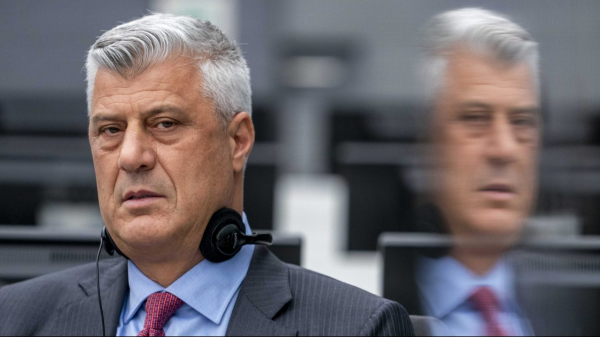
Hashim Thaci at the Kosovo Specialist Chambers in The Hague in November 2020. Photo: EPA-EFE/JERRY LAMPEN.
The Kosovo Specialist Chambers in The Hague has published a less redacted version of the indictment of former Kosovo President Hashim Thaci, who goes on trial with three other Kosovo Liberation Army, KLA ex-officers next month, giving more details of the war crimes and crimes against humanity charges against them.
The latest version of the indictment, filed by the prosecution on February 27, also discloses the names of some of the ethnic Albanian, Serb and Roma victims in the case, as well as details of alleged threats and pressure they exerted against the KLA’s political rivals.
Thaci will go on trial in The Hague on April 3 alongside Kadri Veseli, a former Kosovo parliament speaker and leader of Kosovo Democratic Party, PDK, Jakup Krasniqi, the former chairman of the national council of the Social Democratic Initiative, NISMA party, and Rexhep Selimi, the former head of the parliamentary group of what was the biggest opposition party at the time, Vetevendosje.
The indictment alleges that as part of a “joint criminal enterprise”, the four men committed war crimes and crimes against humanity between at least March 1998 and September 1999, and bear criminal responsibility for nearly 100 murders.
The indictment says they sought to stamp their control over Kosovo “by means including unlawfully intimidating, mistreating, committing violence against, and removing those deemed to be opponents”.
It alleges that as senior figures in the KLA guerrilla force, they had “superior responsibility” which makes them complicit in war crimes and crimes against humanity because they were allegedly aware of violations but did not take action to prevent criminal acts or punish the perpetrators, or they directly participated in the crimes themselves or gave orders for them.
The less redacted indictment discloses that the bodies of 12 ethnic Serb victims were found in a mass grave in 2005.
According to the prosecution, on around July 17, 1998, “a group of 11 Serb detainees were transferred to a room in the basement of a building in Malisheve/Malisevo, where two other Serb detainees were already held”. There they were beaten up.
The prosecution claims that on July 19, “the detainees were placed in a van and driven to a nearby location where they were shot and killed by certain KLA members. One detainee escaped. The bodies of the other 12 men were recovered from a single mass grave in Malisheve/Malisevo in 2005.”
The less redacted indictment also claims that in June 1998, two “opponents” were “arrested, interrogated, and in one case severely beaten” by members of the joint criminal enterprise and people under their control at the KLA’s Drenoc/Drenovac headquarters.
They were then sent away to the KLA’s general headquarters by Thaci and Veseli personally, “with Rexhep Selimi also present”. The two opponents “were never seen or heard from again”, the indictment says.
The indictment defines opponents as people who were perceived by the KLA as either collaborating with the Serbian forces or not supporting the KLA, including being associated with the Democratic League of Kosovo political party, as well as “persons of Serb, Roma, and other ethnicities”.
It further claims that on or around September 20, 1998, Thaci and Selimi, together with other members of the joint criminal enterprise and people under their control, participated in and led the arrest, detention and intimidation of 13 members of a Kosovo parliamentary delegation who were on a humanitarian visit to Qirez/Cirez.
The delegation members were “badly beaten, and had visible injuries” and were asked to renounce Democratic League of Kosovo leader Ibrahim Rugova by Thaci and another man, Sabit Geci.
According to the indictment, in Thaci’s presence, Sabit Geci threatened “to kill a member of the delegation”, and then on their release Thaci reinforced the threat by telling one delegation member that “even if you are free now, we could kill you in Pristina”.
The Specialist Chambers are part of Kosovo’s judicial system but are located in the Netherlands and staffed by internationals.
They were set up in 2015 by the Kosovo parliament, acting under pressure from the country’s Western allies, who believe Kosovo’s own justice system is not robust enough to try KLA cases and protect witnesses from intimidation, after previous trials at the Yugoslav war crimes tribunal were marred by witness-tampering.
The so-called ‘Special Court’ is highly unpopular in Kosovo, where it is seen as unfairly targeting Kosovo Albanian freedom fighters rather than the Serbian perpetrators of the majority of the war crimes that were committed in 1998-99.
Source link: balkaninsight.com