Samir KajosevicPodgoricaBIRNApril 6, 202312:35The European Court of Human Rights rejected a case brought by relatives of war victims deported from Montenegro in 1992 and then mostly killed, ruling that they had already accepted settlements with the Montenegrin authorities.
This post is also available in this language: Shqip
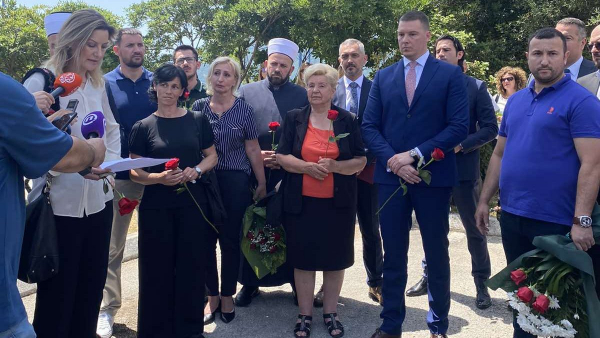
Montenegrin government representatives, civic activists and victims’ families at the wartime deportation commemoration ceremony in Herceg Novi. Photo: Center for Civic Education.
The European Court of Human Rights in Strasbourg on Thursday rejected as inadmissible a case brought by seven relatives of the people who were deported in May 1992 from Montenegro to a detention camp in a Serb-controlled part of Bosnia, where most of them were killed.
On May 25 and 27, 1992, the Bosniaks and Serbs were illegally detained and brought to the police headquarters in Herceg Novi, near the border with Bosnia, from where they were deported on buses to Bosnian Serb-controlled territory.
They were sent to a detention camp in Foca in eastern Bosnia. Only a few survived, and the remains of most of the dead have never been found.
In January 2018, members of the victims’ families brought their case to the ECHR in Strasbourg, complaining that the Montenegrin authorities did not mount an effective investigation into the crime.
However, the ECHR said in its ruling that the Montenegrin authorities “acknowledged in substance a breach of the European Human Rights Convention in both criminal and civil proceedings” connected to the crime.
“Authorities provided the applicants with redress in the form of compensation amounting to a total of 165,000 euros, following which the applicants confirmed that they had thereby been completely compensated for all damage caused by the death of their next-of-kin and had waived all other possible future claims for compensation on those grounds,” the court decision added.
In December 2008. a court settlement with 200 relatives of the victims and several survivors was reached after nearly four years of litigation.
Montenegro paid a total of 4,135,000 euros in compensation to the families for the illegal actions of the police in deporting their relatives.
In 2013, families of the victims sued Montenegro at the European Court of Human Rights in Strasbourg, claiming that the investigation was not conducted vigorously and did not probe all of those who were responsible for the crime, including top officials.
Nine former policemen indicted for the deportations were acquitted in November 2012 because the court ruled that while the arrests were illegal, they did not constitute a war crime and the nine men were not a party to any side in the Bosnian war.
The former government led by Milo Djukanovic’s Democratic Party of Socialists, DPS, never responded to rights groups’ call for a memorial to be installed in Herceg Novi.
The DPS held power in Montenegro from 1990 until 2020, and Djukanovic was prime minister at the time of the deportations in 1992. He is currently the outgoing president of Montenegro.
As part of Yugoslavia under the leadership of Slobodan Milosevic, Montenegro took part in the wars in Croatia and Bosnia.
Source link: balkaninsight.com