Madalin NecsutuChisinauBIRNJune 21, 202312:49OMV and Romgaz announced major plans to exploit gas fields in Romania’s Black Sea waters, pledging to invest 4 billion euros in the development phase.
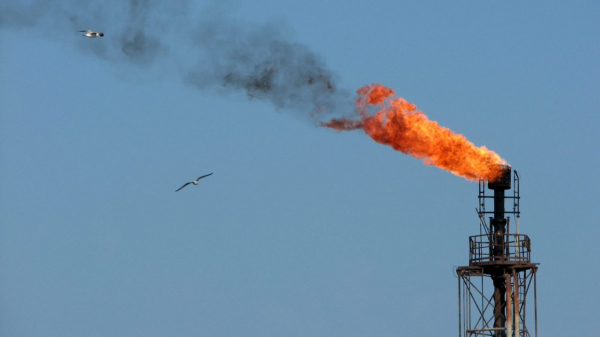
Burning funnel of the Romanian central oil platform on the Black Sea, near Constanta. Photo: EPA/Stringer
Energy companies OMV Petrom and Romgaz on Wednesday backed plans to develop the Domino and Pelican Sud commercial natural gas fields in the Romanian Neptun Deep perimeter in the Black Sea.
The two companies will invest up to 4 billion euros for the development phase of the project, which will generate production of about 100 billion cubic meters of natural gas over ten years.
“To illustrate the size of the project: the production is equivalent to the current annual natural gas demand of about 4.3 million households multiplied 30 times. It is also a major step for our 2030 strategy through which we support the energy transition in Romania and the region,” Christina Verchere, CEO of OMV Petrom, said.
The two companies have equal shares of 50 per cent of this perimeter, and production will be about 8 billion cubic meters annually [about 140,000 B/D] for nearly ten years.
The Neptun Deep perimeter in the Black Sea has an area of 7,500 square kilometres and is located about 160 km from the Romanian shore in waters between 100 and 1,000 meters deep.
The general manager of the Romgaz state company, Razvan Popescu, said that Neptun Deep is a strategic project for Romania and the region to ensure the country’s natural gas needs and energy transition. Romania could also offer gas for export throughout the area, including Moldova, which would reduce gas dependence on Russia’s Gazprom.
“Starting with 2027, we will have a new source of natural gas, which has the potential to increase the country’s natural gas production significantly,” said Popescu.
The infrastructure required for developing the Domino and Pelican Sud offshore natural gas fields includes ten wells, three subsea production systems, a pipeline network, an offshore platform, the main gas pipeline to Tuzla [in Constanta country in Romania] and a gas measurement station.
The platform generates its electricity operating to the highest safety and environmental protection standards. The entire infrastructure will be operated remotely using a digital replica (digital twin). This allows the optimisation of processes and will improve environmental performance by making energy consumption more efficient and reducing emissions.
However, Greenpeace organisation stated that it opposes the project to exploit the gas deposits in the Black Sea on envirommental grounds.
“Offshore gas extraction operations have devastating and irreversible consequences on the marine and coastal environment, as well as significant negative effects on local communities and tourists on the Romanian coast,” said Alin Tanase, Greenpeace Romania’s campaign coordinator.
Source link: balkaninsight.com