Milica StojanovicBelgradeBIRNMarch 17, 202316:44Commemorations were held in Kosovo for victims of ethnic unrest in 2004, when 19 people were killed and more than 900 injured in clashes between ethnic Albanians and Serbs.
This post is also available in this language: Bos/Hrv/Srp
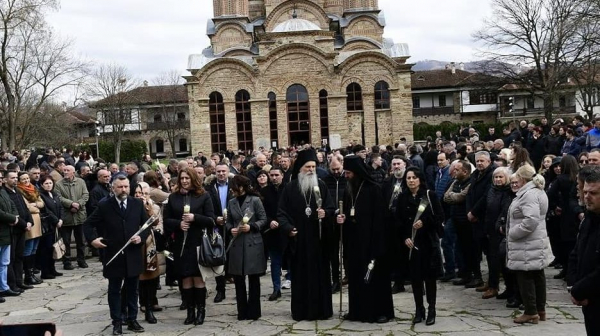
Serbs mark the 19th anniversary of the 2004 violence in Gracanica in Kosovo. Photo: Serbian Office for Kosovo and Metohija.
The 19th anniversary of ethnically-motivated violence against Serbs in Kosovo on March 17 and 18, 2004 was marked in the Serb-majority north of the divided city of Mitrovica and in the town of Gracanica.
Natasa Scepanovic, president of the Association of Kosmet Victims, told a commemorative event at the House of Culture in Gracanica that “we see March 17 as a difficult, sad and unfortunate point in our history in this area, which no one can cover up and downplay”.
Before the event, flowers were laid in front of the ‘Missing’ monument in the yard of the House of Culture.
Memorial services were also held by Serbian Orthodox clergy in Gracanica and Mitrovica, and there were further commemorations in Orahovac/Rehovec and Velika Hoca/Hoce e Madhe.
The deputy director of the Serbian government’s office for Kosovo, Borislav Tajic, said in Mitrovica that “we commemorate and do not forget the pogrom that took place against the Serbian population in Kosovo and Metohija”.
“We remember our destroyed and desecrated shrines, our martyrs, the abandoned hearths of exiled families, the destroyed cemeteries, the murderous wave of demolition, burning, looting and obliteration of everything that is Serbian in the Kosovo and Metohija area,” Tajic said.
A photographic exhibition entitled ‘Crucified Kosovo’ dedicated to the events of March 17, 2004 was also opened at the city museum in the north of Mitrovica.
An official state ceremony led by Serbian Prime Minister Ana Brnabic will be held at the National Theatre in Belgrade on Friday evening.
The US ambassador to Belgrade, Christopher Hill, said that the March 17 events “can serve as a reminder of the risks that we are facing in dealing with the same problems today”, adding that “it is very important to take advantage of the opportunities that [the ongoing Belgrade-Pristina] dialogue is providing to us”.
Hill made his comments a day before Kosovo Prime Minister Albin Kurti and Serbian President Aleksandar Vucic are due to meet in North Macedonia where they will discuss the implementation of a deal they agreed last month on normalisation of relations under European Union mediation.
The 2004 unrest erupted five years after Serbian forces pulled out of Kosovo at the end of the 1998-99 war, amid tensions heightened by the shooting of a Serb youth and the drowning of three ethnic Albanian boys, which was falsely claimed to be ethnically-motivated crime.
According to an OSCE report, 19 people were killed in the violence in 2004 – 11 Kosovo Albanians and eight Serbs.
More than 900 people were injured, including 65 international police officers and 58 Kosovo Police Service officers, and more than 800 buildings destroyed or damaged, including 29 Serbian Orthodox churches or monasteries, the OSCE report said.
International courts in Pristina prosecuted several people who attacked churches, handing down jail sentences ranging from 21 months to 16 years.
Source link: balkaninsight.com