Eleni StamatoukouAthensBIRNFebruary 10, 202313:06The EU has agreed on tougher measures to reduce the number of irregular migrants, amid concerns that the recent devastating earthquakes in Turkey and Syria could prompt new flows.
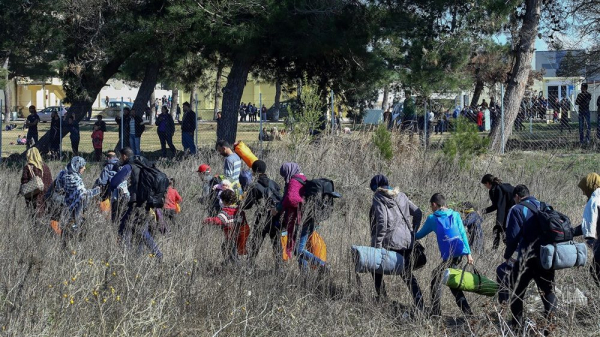
Refugees and migrants trying to leave from Diavata, Thessaloniki, Greece, 25 February 2016. EPA/NIKOS ARVANITIDIS
The 27 member states of the European Union, at a meeting of the European Council on Thursday, decided on measures to reduce the number of irregular migrants in Europe.
“We will act to strengthen our external borders and prevent irregular migration,” said Commission President Ursula Von der Leyen.
The 27 agreed on more effectively controlling the EU’s external borders, strengthening EU policy on returns and readmissions and working on the Pact on Migration and Asylum.
An integrated package of mobile and stationary infrastructure will be provided – from cars to cameras, and from watchtowers to electronic surveillance.
The EU will launch pilot projects focusing on border procedures to showcase best practices – registration, fast and fair asylum procedures, and how to deal with returns. Frontex, the EU Asylum Agency, and Europol will support these pilot projects.
BIRN has found that almost every state on the so-called Balkan Route for migrants and refugees trying to reach Western Europe saw a rise in numbers in 2022, in some cases to the highest level since the crisis began in 2015.
The EU Council meeting was announced on February 3. Three days later, on February 6, deadly 7.8 magnitude earthquakes hit southeastern Turkey and parts of northern Syria. The combined death toll has reached about 22,000.
The new disaster may create a new wave of refugees, Dimitris Triantaphyllou, Professor of International Relations at Kadir Has University in Istanbul, told BIRN.
So far, Turks trying to flee the country have mainly been political refugees. “I don’t know if a part of the Turkish population will decide to come to the EU,” Triantaphyllou said.
There is a decade-long crisis in Syria, a war in Ukraine that is still going on, and now Turkey, “All of these are an explosive mixture for migration,” he said.
Regarding the EU Council’s conclusions, however, Trantaphyllou commented: “It is strange to talk about the hardening of the EU’s external borders on the one hand and solidarity with Syria and Turkey on the other and to announce a donors’ meeting for March; this is a bit paradoxical. But I think it also shows a big dilemma.”
The European Council, under the initiative of the Swedish Presidency and the Commission, will host a Donors’ Conference to mobilise funds in support of the people of Turkey and Syria in Brussels in March.
Since 2008 an annual average of 21.5 million people have been forcibly displaced by climate change. An international think tank, the Institute of Economic and Peace has predicted that by 2050 1.2 billion people could be displaced due to climate change and natural disasters.
Source link: balkaninsight.com