Svetoslav Todorov, Marian Chiriac and Katarina BaleticBelgrade, Bucharest, SofiaBIRNJanuary 29, 202612:29Likely sale of the foreign assets of the US-sanctioned Russian oil giant will have important consequences for fuel supplies in Bulgaria, Romania and Serbia.
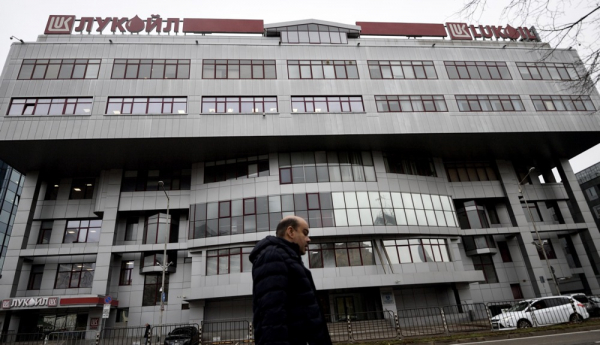
The central office of Russian oil company Lukoil in Sofia, Bulgaria, December 2023. Photo: EPA/VASSIL DONEV.
The US private equity firm Carlyle Group may buy most of the foreign assets of Russia’s second-largest oil producer Lukoil, in a move which will affect several countries in the Balkans, where Lukoil has major holdings and handles most of the oil supply.
“The company is also continuing negotiations with other potential buyers,” a statement from Lukoil on Thursday said.
Approval of such a deal with Carlyle should be issued by the US Treasury’s Office of Foreign Assets Control, OFAC, owing to the existing US sanctions on Lukoil. The Trump administration imposed the sanctions last October, citing Russia’s refusal to end its war against Ukraine.
Lukoil operates in Europe, the Middle East, Africa, Central Asia and Mexico. The Bulgarian branch of Lukoil also sends supplies oil to Romania and Serbia. The refinery in the Black Sea town of Burgas was established in 1998. Bulgaria stopped importing Russian crude oil in March 2024 after a gradual phase-down, shifting to alternative sources from Kazakhstan, Iraq and Tunisia, but still transferred through Lukoil.
In November, Bulgaria amended its laws to enable the transfer of control over the Burgas refinery to escape the US sanctions. The changes were adopted at a meeting of the parliamentary energy commission, which allowed the refinery to be placed under the management of a government-appointed external administrator, with a view to a possible sale.
Former National Revenue Agency director Rumen Spetsov replaced Moscow-appointed chairman Evgeny Manyakhin as the Burgas refinery’s administrator.
Over the past three months, little information has emerged in Bulgaria on the progress of a potential deal. Meanwhile, Bulgaria’s government has since collapsed amid anti-establishment protests and a caretaker government is yet to assume power.
Developments in Bulgaria would have implications for neighbouring Serbia and Romania. In Romania, Lukoil operates some 320 fuel stations and owns the country’s third-largest refinery, Petrotel. It also holds offshore exploration rights in a section of the Black Sea.
The Petrotel refinery supplies roughly one quarter of Romania’s fuel needs. Echoing the move by the Bulgarian government, Romanian officials have stated that greater state oversight of Lukoil’s local operations may be necessary to protect national energy security and jobs.
In Serbia, Lukoil is the second-largest operator of fuel stations after the Oil Industry of Serbia, NIS, running 112 outlets. Together, NIS and Lukoil accounted for nearly one-third of Serbia’s retail motor fuel market in 2024.
NIS is also subject to US sanctions due to its ownership by Russia’s Gazprom Neft. In January, Hungary’s MOL announced plans to acquire a majority stake in NIS from Gazprom Neft. The proposed transaction has been submitted to the US authorities for approval before it can take effect.
Source link: balkaninsight.com