Moldovan President Maia Sandu is giving a speech in memory of the victims of Soviet deportations in Bessarabia on July 6, 2023. Photo: Moldovan Presidency official website Moldova Commemorates Victims of Soviet DeportationsMadalin NecsutuChisinauBIRNJuly 6, 202313:20 Madalin NecsutuChisinauBIRNJuly 6, 202313:20Moldovan leaders have paid homage to the memory of tens of thousands of Moldovans deported to Siberia after the Soviet Union annexed the territory – with the President urging people to ‘keep their memory alive’.
President Maia Sandu and the entire leadership of Moldova on Thursday commemorated the victims of the Soviet deportations from Bessarabia [now Moldova] 74 years ago on the evening of July 5-6, 1949, when Stalin ordered the massive ethnic cleansing of local elites and opponents after the USSR seized these territories following World War II.
«Today marks 74 years since the second wave of deportations that sent 34,270 people to Siberia and Kazakhstan, including 11,245 children. In a single day, our grandparents and parents were loaded into over 1,500 cattle wagons and sent to perish,» Sandu said in front of the monument dedicated to the victims of deportations located in front of the central station in Chisinau.
This was the second and biggest wave of deportations out of the three that the Soviet Union enacted in Moldova. Between 1941 and 1951 there were three waves of deportations, and historians estimate that the total number of deportees was between 80,000 and 120,000.
In the interwar period, Bessarabia, more precisely the territory between the Prut and Dniester rivers, was part of Romania, and most of its population considered themselves Romanian, sharing the same language, traditions and culture. Earlier, however, it had been part of Tsarist Russia and Stalin was determined to add it the USSR.
Last year, the National Archives Agency published the list of people deported between July 6-9, 1949.
“We must keep our deported relatives’ memories alive so that the current generations will not know such terror. For many years we were forbidden to talk about the terror that Moldova went through. We were forced to mourn our pain in secret. Today we can do it openly, and we have to do it,” Sandu said.
The President also recalled the famine in Bessarabia between December 1946 and August 1947. An average of 425 people died per day.
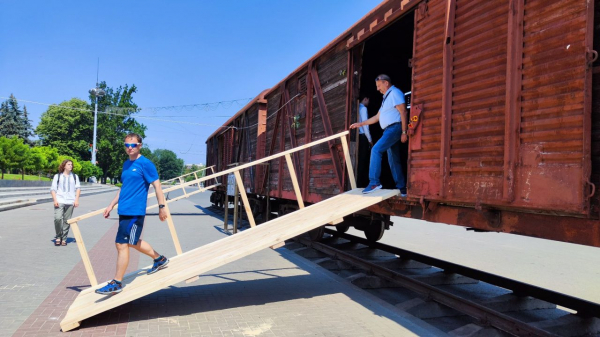
People visit a memorial exhibition on the victims of the Soviet deportations from Bessarabia [Moldova] organised in Chisinau on July 6, 2023. Photo: Moldovan Government
The local Bessarabian elites and peasants were taken by the Soviets to Siberia to forced labour camps, and their assets were confiscated by the Soviet regime under Stalin.
“Soviet deportations had only one goal: to clean Moldova of intellectuals, people with critical thinking, of peasants who did not want to enter the kolkhoz and anyone who did not agree with the regime,” Sandu added.
More than 4,000 members of the Ministry of State Security of the USSR, including those brought from other republics, more than 13,000 officers and soldiers and almost 25,000 party activists from Moldova participated in the deportation operation of July 5-6, 1949.
Also, 4,000 vehicles and 30 trains with 1,570 wagons were mobilized.
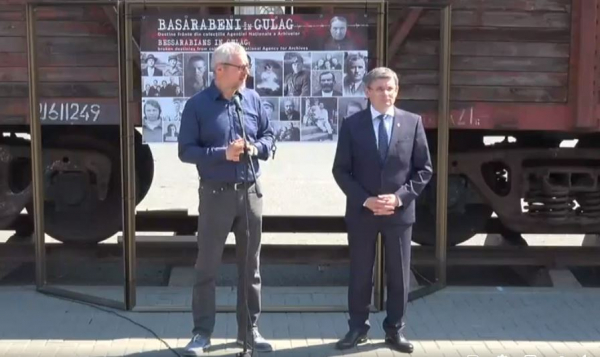
Moldovan Culture minister Sergiu Prodan (L) and the Speaker of Parliament Igor Grosu (R) talk about the historical importance of the Soviet deportations, July 6, 2023. Photo: Moldovan Parliament
The government also inaugurated, on Thursday, an exhibition in the railway station in Chisinau of the wagons in which the locals were deported to Siberia. The wagons were also displayed in front of the government in the centre of Chisinau, in front of the government building.
“I think that such wagons should be installed not only in front of the government but in every village and locality so that we don’t forget. Because we must preserve the memory of the deportees […] If we do not take on this history, then all this ordeal that our parents and grandparents went through was in vain. The biggest crime would be to pass this episode over easily,” said the Minister of Culture, Sergiu Prodan.
The president of parliament, Igor Grosu, said those who survived exile in Siberia and then returned to Moldova continued to fight against the Soviet regime. “They preserved the memory, passed it on to the children, and the religious holidays,” declared Grosu.
“If you don’t know your history and your past, you risk repeating it. What we see now in our Ukrainian neighbours are hundreds of thousands of displaced citizens and children separated from their families.”
“It’s a kind of deja-vu, and you get the impression that what’s left of this rotten [Russian] empire is putting human destinies on the altars of sacrifice,” Grosu added.
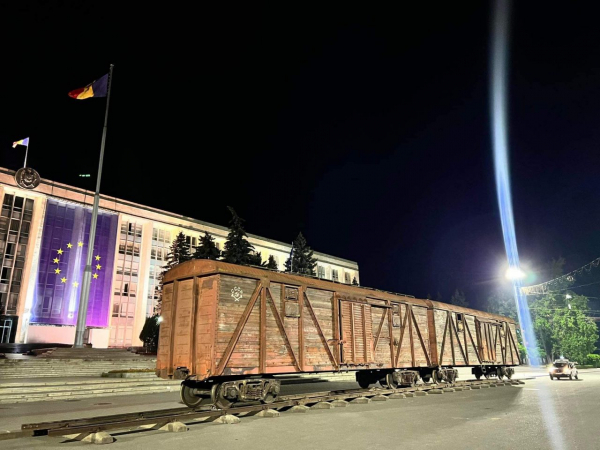
Wagons from Soviet times used to transport Moldovans to Siberia stand in front of the government building in Chisinau. Photo: Igor Casu Facebook page
According to the director of the National Archives of Moldova, Igor Casu, the purpose of the deportations was multiple; one was to frighten the peasants so that they would give up their land and enter the collective farms.
In his view, the deportations were done also to release housing space for the party and state elite, and to provide cheap labour in some regions of the USSR. The last aim was to “decapitate” the local elite.
“The decapitation of the economic, political and intellectual elites [was intended], as they bore the modern national consciousness, in our case, of the modern Romanian one that had barely emerged in the interwar period,” said Casu.
Source link: balkaninsight.com