Sinisa Jakov MarusicSkopjeBIRNJuly 6, 202315:57North Macedonia’s Justice Minister remains defiant after Constitutional Court freezes his decision to add ethnic data to people’s birth certificates.
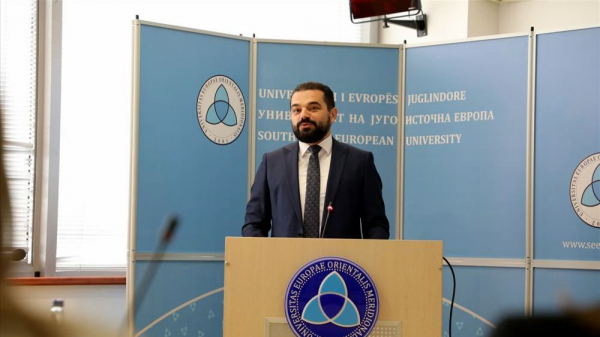
North Macedonia’s Justice Minister, Krenar Loga, wants to see ethnicity data displayed on birth and death certificates as well as on wedding certificates. Photo by pravda.gov.mk
After the Constitutional Court on Wednesday temporary froze Justice Minister’s Krenar Loga order to start issuing birth certificates with ethnic data inside, Loga insisted this would not dissuade him.
The court said it doubts the ministry’s decision issued last month is in line with the constitution, and that while it evaluates this matter, the decision should be frozen. However, it cited a technical omission for the freezing – as the decision has not been published in the Official Gazette within the seven-day deadline.
Loga said his ministry would immediately issue the same decision with a slightly different wording and that this time they would publish it in Official Gazette on time.
His quarrel with the Constitutional Court did not end there as he said the judges had opened a “Pandora’s Box”, as many other decisions are also published late. “I will personally submit dozens of initiatives to the Constitutional Court for the violation of the legal deadline”,,he said.
Loga ordered ethnic data to be added to birth certificates, he said, to prevent people duping set quotas for equitable ethnic representation among employees in the public administration. He said he had come across cases of ethnic Macedonians declaring they were Albanians just to get employed.
He said his intent is for all other personal documents issued by the Office for Management of Registers to contain this ethnic information.
Equitable representation of ethnic Albanians and other smaller ethnicities in the public sector was a key plank of the peace accord that ended a brief armed conflict between government forces and ethnic Albanian guerrillas in 2001. Albanians make up roughly one quarter of North Macedonia’s population.
That goal was largely achieved, but critics say it has also resulted in unwanted effects, such as a bloated public sector filled with party foot soldiers and that favours ethnicity and party affiliation over merit.
Loga was appointed minister at the start of this year, when his Alliance for Albanians party joined the ruling Social Democrat-led government. The party had a long-standing demand to add the ethnic graph.
Before the Constitutional Court issued the freezing order, Loga’s move had already sparked controversy. Loga’s predecessor at the ministry, law professor Renata Deskoska, said the decision was illegal.
“Ethnicity falls in the category of sensitive data that is subjected to special protection in accordance with the rules for personal data protection. Our country has signed the convention on protection of persons during automatic processing of personal data and I personally signed the protocol in December 2019,” Deskoska argued.
Loga dismissed her claim on Wednesday, insisting that “the professor can give any statements she likes, but as a [former] minister she is not a good example”.
The current Law on Birth Registry, from 1995, stipulates that the registry holds data on people’s ethnicity. But this data is not actually displayed on birth certificates issued to people.
The Justice Minister wants to see ethnicity data displayed also death and wedding certificates. His plan is to wrap up the changes by January next year.
Source link: balkaninsight.com