Azem KurticSarajevoBIRNJune 15, 202313:27Joint opinion by the Venice Commission and OSCE urges Republika Srpska authorities to ‘reconsider’ adopting a planned bill which would regulate the work of civil society organisations.
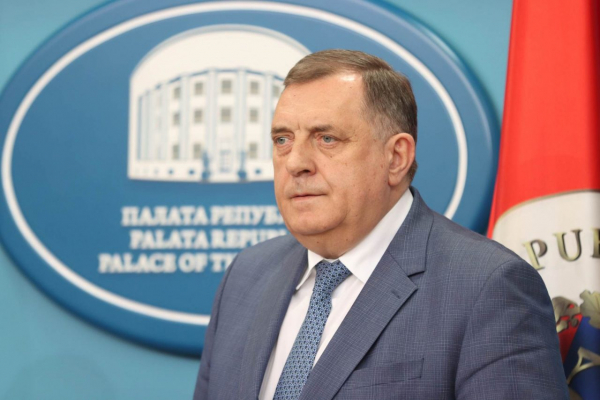
President of Republika Srpska, Milorad Dodik. Photo: Dodik.net
The Venice Commission, the Council of Europe’s constitutional law experts, and the OSCE Office for Democratic Institutions and Human Rights, ODIHR, have warned that the new draft law in Bosnia’s Republika Srpska entity on the “Special Registry and Publicity of the Work of Non-Profit Organisation”, dubbed the “foreign agents law”, “contains serious deficiencies”.
They urged the authorities to “reconsider its adoption entirely.”
The law, announced by the president of Republika Srpska, Milorad Dodik, in early March has already been adopted by the entity’s government.
The opinion, issued on Thursday, urged the Serb-majority entity’s government to engage public and civil society organisations in further development of the law, “to guarantee the enjoyment of the rights to freedom of association and freedom of expression in the Republika Srpska”.
“The joint opinion notes that the bill prohibits non-profits from carrying out ‘political activities’, and requires them to enrol in a special registry, submit additional reports to those already mandatory by the current law and be subject to additional legal oversight,” they added.
The joint opinion criticises the lack of clarity and risk assessment in the development of the draft law, as well as the absence of consultations with relevant associations and those potentially affected. It argues that the proposed legislation’s main justification, of enhancing transparency of foreign funding, is not a legitimate aim in accordance with international standards.
The joint opinion states that there are no substantial reasons provided for the proposed additional registration and reporting requirements for nonprofit organisations. The draft law is deemed excessively vague and ambiguous, making it difficult to anticipate violations and imposing disproportionately severe sanctions. It is also seen as unduly limiting the rights to freedom of association and freedom of expression.
The EU and US have already criticised Dodik’s plans to push a new Russian-style law which would allow the entity to mark civil society and non-governmental organisations as “foreign agents”.
But Dodik has claimed it would be identical to the law in the United States. “In their law, the US refers to foreign non-governmental organisations or those financed by foreigners as foreign agents on US territory,” Dodik said in March, adding that the terminology will simply be adapted, and “instead of US, it will say Republika Srpska.”
The announcement came days after his government adopted draft changes to the criminal code that would impose fines of up to tens of thousands of euros for defamation, which was decriminalised in 2003. Many media outlets in the entity have said this will increase censorship.
Source link: balkaninsight.com