Vuk Tesija, Tommi Siviero and Edit InotaiBudapest, Sarajevo, ZagrebBIRNJune 9, 202316:47EU states’ interior ministers agreed on new policies for dealing with migration including financial penalties for countries that refuse to accept relocated migrants, but Poland and Hungary vowed to resist the changes.
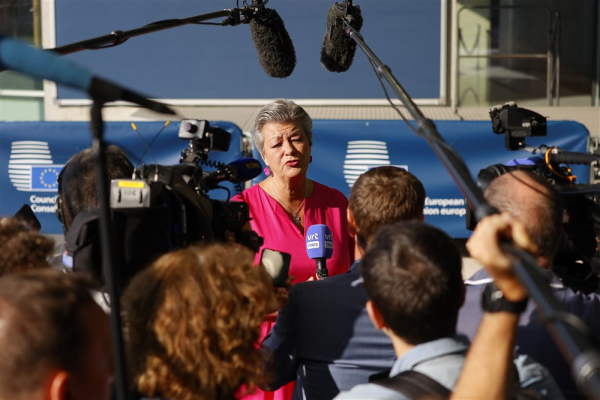
European Commissioner for Home Affairs Ylva Johansson. Photo: EPA-EFE/JULIEN WARNAND
The interior ministers of EU member states agreed on Thursday in Luxembourg on a common position to revamp the bloc’s migration and asylum policy, although staunchly anti-migration countries Hungary and Poland voiced strong opposition.
“These proposals represent the two main pillars of the asylum system reform and are key to the balance between responsibility and solidarity,” a delegation led by Sweden’s Migration Minister Maria Malmer Stenergard, who chaired the Luxembourg talks, said in a statement.
“This is a great achievement for Europe,” said European Commissioner for Home Affairs Ylva Johansson.
Instead of binding quotas for distributing migrants arriving in the EU around member countries, which some Central and Eastern European states did not agree to, countries that do not want to receive migrants will have to contribute financially or in some other way to joint efforts to manage migration.
Media reports have said there will be charges of 20,000 euros per person for member countries that refuse to host refugees.
The agreement now goes to the European Parliament for discussion and adoption. If the entire package is adopted by June next year as envisaged, it will begin to be implemented two years later, in 2026.
The Hungarian government said it is completely opposed to the plan, however.
“Brussels is abusing its power. They want to relocate migrants to Hungary by force. This is unacceptable! They want to pressure Hungary to become a country of migrants,” Prime Minister Viktor Orban wrote on Facebook.
An official Hungarian government statement was similarly combative: “Mandatory resettlement of migrants was passed in Brussels. Whoever resists must pay. Hungary does not want to be part of this.”
Istvan Hollik, the communication director of governing party Fidesz said that Hungary will challenge the pact wherever it can, and if necessary, will turn to the European Court of Justice.
Hollik called it “outrageous” to charge countries 20,000 euros per person if they do not want to accept migrants.
He accused the EU of not respecting unanimity and said it pushes the bloc towards becoming an “empire”.
The Hungarian government insists that decisions about migration should be reached at the European Council, at the level of prime ministers and heads of state level, where unanimity is required and where Hungary and Poland can effectively block any migration deals.
Zsolt Szekeres, a migration expert from the Hungarian Helsinki Committee NGO, told BIRN that the Hungarian government regularly pushes for a “common solution” on migration, but cannot tolerate other member state’s position or come forth with its own suggestions.
“The government’s interest is to stir up tensions at a European level which can be used for domestic purposes, rather than look for common solutions,” Szekeres said.
He added that the new asylum procedure will put pressure on the Hungarian government to change its current practice which does not allow asylum-seekers to submit applications at the Hungary’s borders and regularly pushes them back to Serbia.
“The agreement envisages that asylum applications at the border will have to be processed by the authorities and adequate facilities have to be established, instead of simply turning back people,” he said.
Polish Interior Minister Bartosz Grodecki said that his government would refuse to pay the financial penalties for not taking in refugees.
“Politically, pragmatically, this mechanism is unacceptable to us,” Grodecki said, Euractiv reported.
However, Italy approved the agreement, distancing itself from Prime Minister Giorgia Meloni’s usual anti-migrant allies, Poland and Hungary.
“Italy has obtained consensus on all the proposals put forward during today’s Council… We wanted to ensure that no formulations in the texts would weaken the possibility of reaching agreements with third countries,” Italian Interior Minister Matteo Piantedosi told media.
Piantedosi seemed to be referring to a concession that was reportedly granted to Italy in exchange for its green light.
Politico reported that under the agreement, in line with Italy’s wishes, EU states will have more freedom to send rejected migrants to what individual governments determine to be a “safe third country”, so they can be deported to countries that are not their own, as long as they have some kind of connection with the country.
This is an issue that has been the focus of the Italian government’s migration policies since it took power in October 2022.
The European Council on Refugees and Exiles said that the agreement “reduces protection standards in Europe” for migrants and asylum-seekers.
“Whether it will meet its other objectives of deterring arrivals, rapid returns or reducing so-called secondary movement remains to be seen,” it added.
Source link: balkaninsight.com