The Holocaust Memorial Museum in Skopje. Photo by BIRN Goran Sadikarijo: Dressing up as Hitler Shouldn’t be ‘Funny’ in North MacedoniaFrosina DimeskaBIRNMay 22, 202309:12 Frosina DimeskaBIRNMay 22, 202309:12The Director of the Holocaust Fund in North Macedonia says the horrors of the Nazi genocide are in danger of being forgotten by younger generations.
“That’s what you deserved, they did too little to you…”
This kind of message was left in the visitors’ book of impressions at the Holocaust Memorial Center in North Macedonia.
This message is now gone. When they notice these types of messages, the staff of the center change the books in the museum where visitors leave their impressions. They do this so that anti-Semitic messages do not get passed on to future visitors.
That hateful message was just from one man. But the pandemic, unlimited access to the internet, ignorance, the lack of attention to young people at home, as well as the poor education system, all contribute to others sharing similar sentiments.
Public figures are contributing factors to these concerning trends as well. The US rapper and record producer Kanye West, made a series of anti-Semitic comments and even praised Hitler. West has since been banned from social media, but his interview with American conspiracy theorist Alex Jones is still available on YouTube.
That is one extreme: blatant justification and glorification of someone who was directly responsible for the deaths of more than 6 million Jews in World War II. But the normalization of fascism is equally dangerous, done through referencing Hitler in a manner emptied of historical context.
Satirical approaches to the subject of Hitler and fascism are not new. In 1940, when the World War II was in full swing, Charlie Chaplin filmed The Great Dictator, a political-satirical film through which Hitler, anti-Semitism and Nazism are mocked.
Similar cinematic and artistic examples can also be found today. The 2019 film Jojo Rabbit does that, mocking Hitler and his ideology while pointing to the historical catastrophe caused by fascism.
However, a critique of Nazism was not present in the meme that the tech mogul Elon Musk shared on Twitter last year. Criticizing Canadian Prime Minister Justin Trudeau’ attitude towards truckers’ protests against Covid vaccinations, Musk compared him to Hitler through a meme.
An avalanche of reactions accused the tech giant of belittling one of the world’s largest genocides, simply because he disagreed with a politician. After the controversy, Musk deleted the tweet.
Today, Hitler appears in many corners of the Internet as a funny character, while the Nazi “Zig Heil” greeting may even be a gesture that your classmates greet you with. The well-known and easily replicable moustache of the Führer has become a quick mask for April Fool’s jokes.
In the everyday life of young people, Hitler’s character is often emptied of historical meaning. The pandemic generations took classes online starting from the third grade. According to the Macedonian curriculum, they are only expected to learn about World War II in the ninth grade.
Throughout the period from the third to the ninth grade, however, many young students are exposed to misinformation, fake news and distortions of history. And often they receive all of this without any adult supervision or parental control.
“We as parents should look in the mirror and ask ourselves if, in the race to provide our families’ livelihoods, we have left our children only to the educational system, which in turn is no longer adequately involved in young people’s upbringing,” Goran Sadikarijo, Executive Director of the Holocaust Fund, told BIRN.
Obligations undertaken, then forgotten
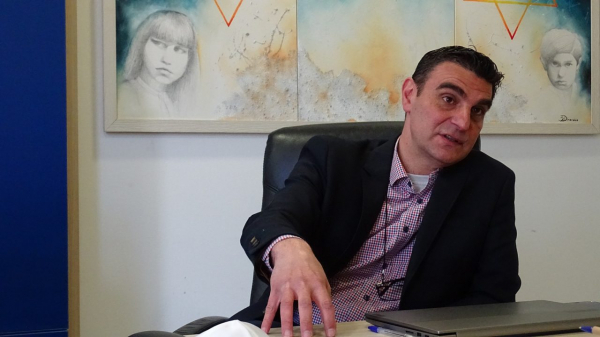
The fund reacts constantly to anti-Semitic occurances. Photo by BIRN/Vasko Magleshov
The education system today is different from the one in the time of Yugoslavia. In the curricula of the former system, Sadikarijo said, “there was more focus on World War II and the liberation movement”.
However, he adds, “The Holocaust was not covered enough either then or now, because in the system at the time, Jews were treated as part of the Yugoslav tragedy without emphasizing the Holocaust as a unique genocide in the history of mankind.”
Currently, there are lessons in schools about the Holocaust, but Sadikarijo says they are “minor”.
In 2021, before the International Forum for the Remembrance of the Holocaust and the Fight against Anti-Semitism, North Macedonia pledged to change its curriculum.
A government session decided that, in the next two years, the curriculum for the eighth and ninth grades would include “content that will deal with anti-Semitism and Holocaust denial”.
The other commitment, according to the minutes of the government session, is that the excursion calendar for middle and high school students would include “a mandatory visit with included educational content to the Holocaust Memorial Center of the Jews of Macedonia in Skopje”.
These plans have yet to be realized. At the moment, most of the visitors to the Memorial Centre in Skopje are foreign tourists. Whether some Macedonian students end up visiting the center or not depends on their teachers.
Problem is ‘not only with children but adults’
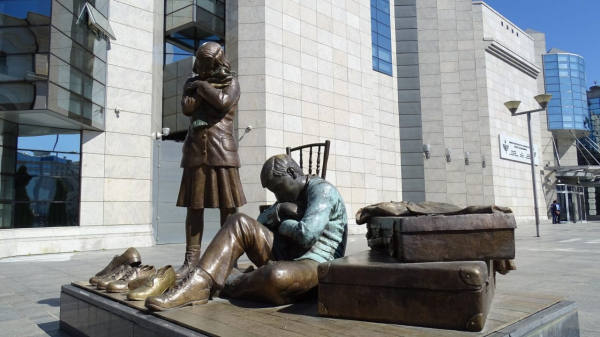
A statue in front of Skopje’s Holocaust Memorial Museum. Photo by BIRN/Vasko Magleshov
BIRN spoke with Sadikarijo in his small office located in the Holocaust Fund building. Jewish symbols were all around – pictures with the Star of David hang on the walls, and on the table, in addition to many printed materials about the Holocaust as well as the traditional hat worn by Jews.
He spoke emotionally about the tragedy that befell the Macedonian Jews. The then Bulgarian government – an ally of Nazi Germany – took 7,144 Jews from their homes. The Bulgarian occupiers then put them on trains leaving from Skopje’s Monopole factory and sent them to the death camp in Treblinka; 98 per cent of the total Jewish population from today’s North Macedonia were killed there, which is among the largest percentages in the world.
Sadikarijo’s sentiments can be felt more viscerally when walking through the memorial center. When BIRN visited, there was one visitor and several employees, who were preparing for their next activity. Silence filled the space – something to be expected in a place intended to convey the eerie events that happened 80 years ago to a contemporary audience.
The decades that have passed since World War II, as well as the lack of living witnesses to pass down their tragic life stories to their descendants, are some of the reasons why parts of the younger generations seem to forget the dangers that led to the genocide against the Jews in the first place.
Particularly, on April 1, this year – a day when masquerades are traditionally held – in a primary school in Skopje, a student dressed up as Hitler. He walked around the school yard and got a few laughs from his classmates, while no teachers took any actions.
But, discussing such events with Sadikarijo, he emphasized that the problem “is not only with children, but also with adults”.
The Holocaust Fund and the Jewish Community in North Macedonia condemned another masquerade held in Strumica at the end of February, where an image of Kostadin Kostadinov, mayor of Strumica, dressed as former Yugoslav leader Josip Broz Tito, was circulated online. The mayor was photographed standing next to a man dressed up as Hitler, with the Nazi flag waving near them.
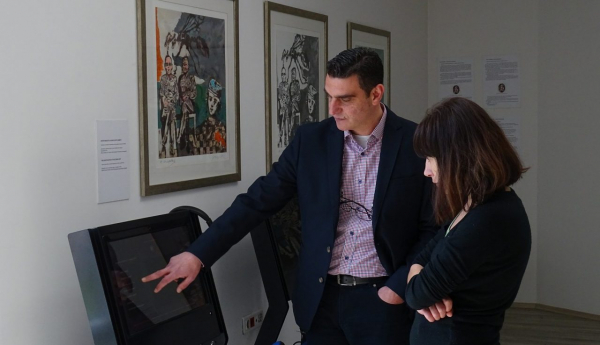
Most of the visitors of the Memorial Museum are foreign tourists. Photo by BIRN/Vasko Magleshov
“Just a few days after the carnival was held on March 1, 2023, graffiti with a Nazi symbol, the swastika, appeared on the fence of the Jewish Community Building. Did the public promotion of Hitler’s mask encourage the writing of this graffiti, the Jewish community at the time asked?
Sadikarijo remains perplexed as to how “a public figure cannot recognize what a problem he created by posing next to a man dressed up as Hitler, while justifying himself under the guise of freedom of speech, humour and political satire”.
The fund keeps records of anti-Semitic instances, such as Nazi symbols in schools and cities, public anti-Semitic attacks and inappropriate masks. Some simply sit in their archives, while others get reported to the police and public prosecutor’s office.
Sadikarijo mentioned two cases of online dissemination of anti-Semitic material that are currently banned. One is the Facebook group Ninurta, and the other is the website Blood and Honor Macedonia. Now they cannot be found, but it is still not clear whether any disciplinary measures were taken against the creators and administrators.
“We always react and are alert to such deviant occurrences because when [anti-Semitic] graffiti appears, it leads to [hateful] slogans that could eventually turn into physical harm or destruction of property,” he said
Thirteen years ago, the gate of the Jewish cemetery in Bitola, which dates back to 1947, was desecrated by graffiti with Nazi symbols. In fact, news of swastikas drawn in public places in the town is quite common. Sadikarijo specified that that in the case of Bitola, the incident had to do with the leaders of the football Chkembari fan group, with whom they had a meeting where the group apologized and erased all the Nazi symbols.
He spoke with pride about the Jews in the country, most of them migrated from the Iberian Peninsula from where they were exiled in the 15th century. The Ottoman Empire, which ruled the Balkans, needed more educated people, as were Jews at the time. The community spoke the Judeo-Spanish language known as Ladino.
Indeed, Sadikarijo used a Ladino proverb when asked about why it is important to continue speaking about the Holocaust, 80 years later. “Without memory, there is no future,” he told BIRN.
Source link: balkaninsight.com