Hungary’s President Katalin Novak signs a guestbook during her visit to the Portuguese Parliament in Lisbon, Portugal, 24 February 2023. EPA-EFE/MIGUEL A. LOPES Democracy Digest: Hungarian President Vetoes Controversial Anti-LGBT LawEdit Inotai, Peter Dlhopolec, Tim Gosling and Claudia CiobanuBratislava, Budapest, Prague, WarsawBIRNApril 28, 202308:43 Edit Inotai, Peter Dlhopolec, Tim Gosling and Claudia CiobanuBratislava, Budapest, Prague, WarsawBIRNApril 28, 202308:43Elsewhere, prosecutors launch investigation into Donald Tusk, leader of the main opposition party, for abuse of power; Czech president at odds with the government; and former Slovak PM Robert Fico says ‘yes’ to Ukraine in the EU, ‘no’ to it joining NATO.
As Hungary gears up for Pope Francis’s arrival on Friday, the government’s natalist and ‘family values’ policies were under the spotlight again this week. In an unexpected move, Hungarian President Katalin Novak sent a bill back to parliament arguing it wasn’t consistent with the constitution. The Hungarian parliament approved a law earlier in April that in theory transposes an EU directive protecting whistleblowers, but actually contains a paragraph that would enable citizens to anonymously denounce people who contest the “Hungarian way of life”. This could include anything from challenging the “constitutionally recognised role of marriage and the family”, to questioning children’s rights “to an identity appropriate to their sex at birth”. Critics claim the bill is just another vicious attack on the LGBT community and same-sex couples with children, and specifically targets families with transgender youth.
President Novak, a former family affairs minister, is seen as a loyal ally of Prime Minister Viktor Orban, but also someone who cleverly navigates European diplomatic circles. She argued that the paragraph on “protecting the Hungarian way of life” does not belong to the EU Whistleblower Act (she called it a “foreign body” in the legal text) and claimed it weakens rather than strengthens constitutional rights, as it is not in line with a fundamental value also anchored in the constitution, freedom of speech. The law is also loosely worded, giving too much room for interpretation, she added. Using her veto means the law goes back to parliament, though MPs can still decide to adopt it as it is. Many wonder whether this is another shrewd political game by Orban, who might have got signals from the European Commission that he had gone too far with this law and now needs a ‘face-saving deal’ to get his hands on frozen EU funds. Yet there are others who think Novak is establishing herself as a less-radical alternative to Orban.
The government intends to decriminalise defamation and libel in the media – a step which people not familiar with Hungarian politics could mistake as a positive step to strengthen free speech. The governing Fidesz party submitted a draft law to parliament that would significantly lower punishment for defamation in the media, which currently allows for up to two years in prison. Fidesz parliamentary leader Mate Kocsis argued that defamation and slander should no longer fall under the Penal Code and when committed during the free exchange of public discourse only be punishable if it is coupled with an “obvious and seriously derogatory denial of the victim’s human dignity”. Kocsis also argued that criminal law should only be the last resort when discussing public affairs, and the person insulted can always seek reparation in a civil legal process. Yet critics warn the change will mostly benefit government-close media and trolls, who could now display even less restraint when launching personalised and often vulgar attacks against opposition politicians and activists criticising the government. According to investigative news site Atlatszo, government-close media outlets lost 29 defamation cases in 2022, while the critical media lost only six in total.
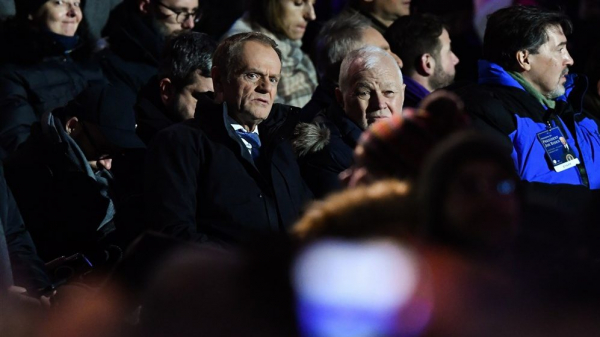
Leader of main opposition party Civic Platform (PO) Donald Tusk (C) awaits US President Biden’s speech at the Kubicki Arcades in the gardens of the Royal Castle in Warsaw, February 21, 2023. US President Joe Biden was in Poland for a two-day visit. EPA-EFE/Piotr Nowak
Polish opposition leader investigated; no money for dissenting academics
Donald Tusk, leader of the main opposition PO party, is under investigation by Warsaw prosecutors for abuse of power. The crime potentially carries a prison sentence of up to 10 years. The investigation is related to one of the biggest scandals in post-Communist Poland, which was the publishing of recordings of multiple conversations between liberal politicians from Tusk’s former government and businessmen. The recordings published by a number of different outlets, on which PO politicians could be heard making unofficial deals and using fruity language, are thought to have contributed significantly to the government’s demise in 2015. Prosecutors are examining whether Tusk abused his powers as PM to order a check of the company of the businessman responsible for making the recordings. Marek Falenta’s company was importing Russian coal to Poland at the time and Tusk has claimed the publishing of those recordings were in Russia’s interest, as they helped bring down his government, which opposed energy dependence on Russia. Tusk further claimed Falenta sold the recordings to the Russian security services and that members of the Polish intelligence services loyal to PiS were involved in the operation. Back in 2016, Falenta was sentenced to two and a half years in prison for illegally making the recordings.
Education Minister Przemyslaw Czarnek said no public money would be made available to academics who “insult Poles”, in response to Barbara Engelking, a leading Polish Holocaust scholar, claiming last week that Poles did little to help Jews during World War II. Engelking made the comments during the 80th anniversary of the start of the Warsaw Ghetto Uprising, when hundreds of Jews took up arms to prevent the planned extermination of all Jews imprisoned in the ghetto by the Nazis. PM Mateusz Morawiecki and other key PiS politicians condemned the scholar’s remarks and Poland’s national broadcasting regulator started an investigation into TVN, the private television station on which Engelking made her remarks. Engelking heads a research institute that is part of the state-funded Polish Academy of Sciences (PAN). “While I do not intend to influence staff policies at PAN, I will be reviewing final decisions, because I will not finance on a larger scale an institute that supports the kind of people who insult Poles,” Czarnek said on TVP, the state broadcaster.
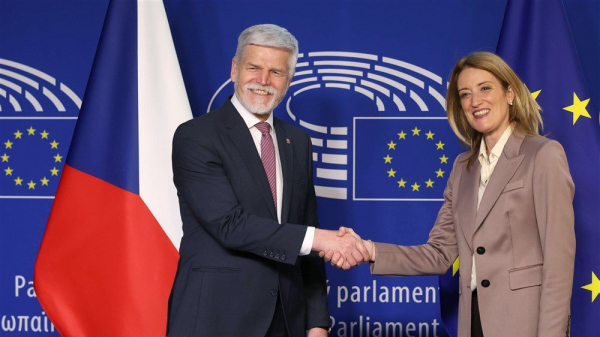
European Parliament President Roberta Metsola (R) welcomes Czech President Petr Pavel ahead of a meeting in Brussels, Belgium, 21 April 2023. EPA-EFE/OLIVIER HOSLET
Czech president at odds with government; polarisation fears; Kirill sanctioned
It didn’t take long for the first dispute between Czechia’s new president and the government to emerge. Although former NATO general Petr Pavel was viewed before his inauguration last month as a likely ally of PM Petr Fiala, he’s already showing that he’s ready to press Petr Fiala to live up to promises to shore up democracy. Over the weekend, the president, anything but a woke social justice warrior, slammed the government for failing to join 15 EU states in supporting the EU Commission’s lawsuit against Hungary’s anti-LGBT laws. He also said he’ll demand the PM explain why his government continues to delay adoption of the Istanbul Convention against sexual violence.
However, it’s not only social and cultural issues testing the patience of those persuaded to back Fiala as the leader of the broad coalition that unseated populist billionaire Andrej Babis in elections in 2021. Concern is also rising that the government is deepening the polarisation of Czech society as it starts to roll out its economic program. Sweating on keeping his conservative, middle-class base happy, Fiala is steadfastly refusing to raise income tax. So, as he casts around for ways to slash the budget deficit, pensions have been curtailed and a rise in VAT is being mulled. That has many worrying that the recent wave of protests against the government’s handling of the cost-of-living crisis – which have a whiff of pro-Russia about them – are set to swell. Many noted that around a million votes in 2021 went to anti-system parties extolling left-wing economic policy that did not make it into parliament. Despite paying lip service to this cohort after taking office, Fiala and his government appear happy to now ignore it. Pavel discussed such complaints on Wednesday when he met union leader Joseph Stredula. And it’s also becoming clear that not only is the PM’s neo-liberal agenda annoying such critics, it’s also starting to affect the unity of the five-party coalition.
Czechia used its “Magnitsky Act” for the first time Wednesday, adding Vladimir Mikhailovich Gundayev to the newly-minted sanctions list. Better known as Patriarch Kirill, head of the Russian Orthodox church, he is now banned from entering the Czech Republic or accessing any funds in the country. As well as freezing the assets of the bishop, who has officially blessed Russia’s vicious invasion of Ukraine, the move can be read as a pop at Hungary. Kirill was set to be sanctioned by the EU last June, but was removed from the list over objections by Viktor Orban that it would infringe “religious freedom”. The Act, modelled on the US one that authorizes the US government to sanction those found to be gross human rights offenders or those involved in significant corruption, allows Prague to levy sanctions against targets not covered by EU penalties. The bishop belongs on the list “because faith cannot be used to justify the atrocities committed by Russian soldiers in Ukraine,” Foreign Minister Jan Lipavsky wrote, noting Czechia is returning to an assertive foreign policy with human rights at its core.
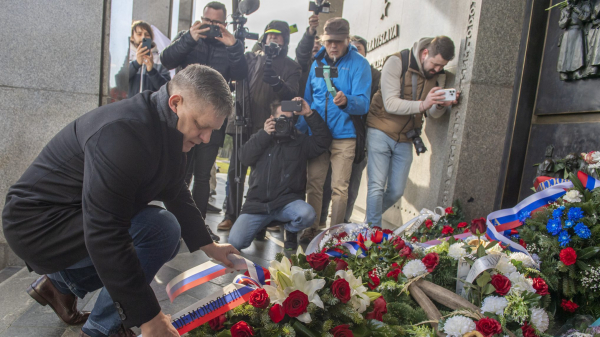
Chairman of Smer-SD party Robert Fico lays a wreath on the 78th anniversary of the liberation of Bratislava at the Slavín monument in Bratislava on April 4, 2023. PHOTO TASR – Martin Baumann
Fico says ‘yes’ to Ukraine in EU, ‘no’ to NATO; did Russian embassy damage graves?
Smer leader and former PM Robert Fico this week invited a group of ambassadors to a meeting to discuss various problems that Slovakia is coping with, though the war in Ukraine stood out. Fico said he has nothing against Ukraine joining the EU if all the criteria are met. On the other hand, he would not support Ukraine as a NATO member if his party formed a government after the September election. In addition, he promised to stop Slovakia’s military support of Ukraine. The ambassadors, however, said their countries stood by Ukraine in all aspects. US ambassador Gautam Rana called on Smer to reject Vladimir Putin’s false narratives. “Aligning with Putin is appeasement, no different than the appeasement offered to Hitler,” the ambassador said. “It did not work with Hitler then, and it won’t work with Putin today.” But Fico thinks the West’s ultimate goal is to destroy the Russian Federation. He has also repeated the false claim that the Russian-Ukrainian war is a conflict between the US and Russia. After Fico met ambassadors in February, they criticised Smer for spreading disinformation.
The Russian embassy in Bratislava managed to desecrate the graves of Russian and Austro-Hungarian soldiers at the World War I cemetery in Ladomirova, eastern Slovakia, in 2014, when it replaced kerb surrounds around the graves of Russian soldiers buried at the cemetery, the Denník N daily reported. The embassy declined to comment. The same cemetery was the subject of a hoax by the Russian embassy last year, when it claimed that a former Ladomirova mayor had the cemetery razed to the ground when, in fact, the ex-mayor only had the crumbling kerb surrounds removed. Even though the police labelled the embassy’s claim a hoax, Prosecutor General Maros Zilinka nevertheless decided to investigate the alleged ‘crime’. The investigation is still ongoing. The Interior Ministry and experts from the Monuments Board, a body which protects monuments and historical sites in Slovakia, recently confirmed that the Russian embassy failed to carry out any survey before it decided to replace the concrete kerb surrounds in the cemetery. Overgrown with grass for almost a decade, experts say it had to be impossible to place these kerb surrounds in the right places without a proper survey. As a result, kerb surrounds ended up running across the graves. Some digging also had to be done. The Russian embassy paid for this restoration work and so, under a 1995 bilateral agreement signed by Russia and Slovakia, did not need any permits.
Source link: balkaninsight.com