Xhorxhina Bami and Ilirjana HotiPristinaBIRNApril 27, 202316:03Events were held to mark Kosovo’s Day of Forcibly Disappeared Persons, while hundreds of people also attended a ceremony to commemorate the anniversary of a wartime massacre in the village of Meja.
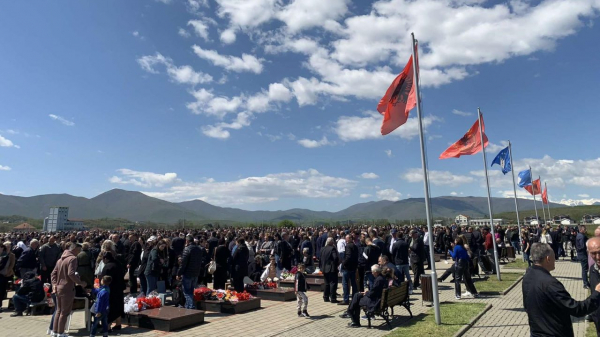
Kosovo Albanians commemorate the anniversary of the Meja massacre on Thursday. Photo: BIRN.
Kosovo on Thursday commemorated its annual Day of Forcibly Disappeared Persons with events intended to remember those who went missing during the 1998-99 war and to reiterate demands for justice.
The Youth Initiative for Human Rights Kosovo inaugurated a plaque in front of a missing persons memorial outside parliament in the capital Pristina in order to give the public more information about the two-metre-high white marble monument, which is called To Those We Miss.
Marigona Shabiu from the Youth Initiative for Human Rights Kosovo said on Thursday that “this memorial installed some years ago here in Ibrahim Rugova Square never properly identified what the memorial shows and who it is dedicated to”.
The plaque gives the memorial’s name in five languages used in Kosovo, including the official languages, Albanian and Serbian, as well as Turkish, Romani and English.
“The action is a critique of public institutions that do not do enough for the civilian victims of the war in Kosovo, including those who have not been found, starting from the maintenance of memorials and their installation in important, visible spaces,” Shabiu said.
Kosovo Prime Minister Albin Kurti, parliamentary speaker Glauk Konjufca and former President Atifete Jahjaga also paid tribute at the missing persons monument in Pristina.
There are 1,621 missing persons from the Kosovo war whose remains have not yet been found. They are mainly ethnic Albanians but some are Serbs and Roma.
In a statement to mark the Day of Forcibly Disappeared Persons, the EU rule-of-law mission in Kosovo, EULEX, explained the difficulties involved in finding the remaining missing persons.
It cited Javier Santana, deputy director of the Institute of Forensic Medicine and a EULEX forensic archaeologist, Javier Santana, as saying that forensic experts face problems such as the burial of war victims “in small, clandestine graves, or even in cemeteries… to hide evidence of these crimes”.
Santana also said there was a lack of new information about gravesite locations, as well as a lack of DNA samples from some families in order to identify human remains and what he called “the issue of misidentifications”.
“In the aftermath of the war, bodies were identified in a summary way, for example through pictures or clothes, resulting in mistakes which are difficult to trace and rectify today,” he said.
April 27 coincides with the anniversary of a massacre in the western Kosovo villages of Meja and Korenica in 1999, when 377 ethnic Albanians were murdered by Serbian forces.
Kurti, Konjufca and Jahjaga attended a ceremony in Meja, alongside several hundred locals, to remember those who died.
“We need justice, we need accountability, we need the criminals, the culprits, the executioners and the order-givers to be behind bars, and for this we need international support as well as national mobilisation,” Kurti said.
“Next month it will be four years since parliament enabled prosecution, indictment, trial and punishment in absentia, and there is no more appropriate day than April 27 to call on the state prosecution once again… for those thousands of testimonies that we have about the crimes that were committed to be turned into indictments of those who were responsible,” he added.
Source link: balkaninsight.com