Svetoslav TodorovSofiaBIRNApril 4, 202316:59Stalemate in Bulgaria is likely to continue unless serious compromises are made by GERB’s Boyko Borissov and We Continue the Change’s Kiril Petkov after Sunday’s close-run elections, although this is unlikely.
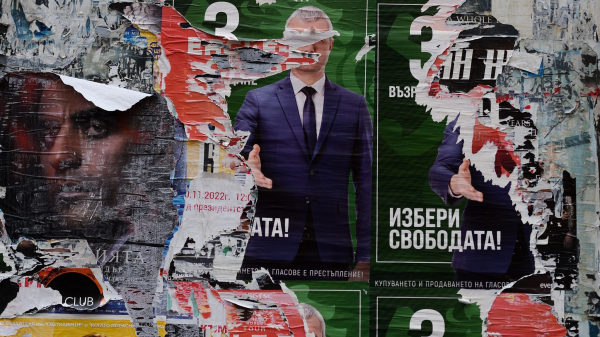
Torn election posters of Kostadin Kostadinov, leader of Bulgaria’s pro-Russian ultranationalist party Revival, the day after the parliamentary election, in Sofia. Photo: EPA-EFE/VASSIL DONEV
Uncertainty loomed over Bulgaria on Tuesday following the April 2 elections as the final results showed that there will be no easy way for parties to build a governing coalition and any effort to form an administration will require serious compromises.
On Tuesday, the leading parties were unusually quiet, with no press conferences or major statements from Boyko Borissov’s GERB after coming out on top in the polls and nothing from runners-up We Continue the Change either.
On Monday evening, the Central Electoral Commission put the voter turnout at 40.63 per cent – in some regions it was as low as 26.82 per cent – and issued the final results of what was the fifth general election in the last two years.
Similar to the elections in April 2021 and October 2022, GERB/United Democratic Forces, led by Boyko Borissov came out just ahead with 26.5 per cent of the vote.
We Continue the Change/Democratic Bulgaria led by reformist ex-premier Kiril Petkov won 24.5 per cent.
Pro-Russia party Revival won 14.2 per vent, GERB’s only clear cut allies Movement for Rights and Freedoms 13.7 per cent, the Bulgarian Socialist Party 8.9 per cent and There’s Such a People did surprisingly well with 4.1 per cent.
“There are just enough Bulgarians who prefer to live in a feudal state and have a designated master – this works for GERB,” political analyst and author Evgeniy Dainov wrote on the dnevnik.bg website, commenting on GERB’s first placing.
Dainov said that he sees the 2021-2022 cabinet led by Petkov as a missed chance for reformist politics, while bemoaning the increase in support for the Kremlin-sympathetic Revival party.
“A lot of parties are seeing pro-Putin sentiments as so widespread that it would be pointless to criticise them – this passive attitude informs and legitimises the rise of Revival,” he said.
The Central Electoral Commission’s data showed that while Petkov’s alliance led in Sofia and the second biggest city of Plovdiv, GERB dominated in Varna and in the smaller towns. Petkov also won the popular vote among Bulgarians in the US and across Europe.
However, this wasn’t enough to overtake GERB despite initial predictions of a narrow win.
The Bulgarian Socialist Party’s popularity continued to drop in the election and it failed to attract far-right voters after building its campaign around fighting ‘gender ideology’ and sex education.
Opinion polling by Alpha Research indicated that several thousand former Socialist Party voters supported a new alliance, The Left Wing!, consisting of former Socialist members, which in the end did not reach the threshold to get into parliament.
There’s Such a People, led by popular entertainer Slavi Trifonov is back in parliament despite the erratic decisions that followed its July 2021 election victory. The party joined and then left Petkov’s coalition and did not reach the threshold to get into parliament in the last elections in October.
The Movement for Rights and Freedoms party, relying almost entirely on votes from the Turkish and the Roma minorities, has remained stable through the election cycles and have won the vote among Bulgarian citizens living in Turkey and Moldova. International sanctions and controversies around the Movement for Rights and Freedoms did not affect its performance.
President Rumen Radev, who abstained from commenting on election day, said on Tuesday that parties should kickstart the new parliament as fast as they can and finalise the adoption of the annual state budget and draft laws related to the European Recovery and Sustainability Plan.
Meanwhile, as the latest political turmoil unfolds, the interim cabinet, selected by Radev and including some individuals associated with pro-Kremlin statements, has initiated the replacement of Bulgaria’s ambassadors in various countries.
Source link: balkaninsight.com