A woman holds a banner that reads «I am not to blame for being born a girl» in a «Red Shoes» installation in the Mother Teresa square in Tirana, Albania, for awareness of violence against women. Photo: BIRN/Nensi Bogdani Southeast Europe Marches for Women’s RightsXhorxhina Bami, Fjori Sinoruka, Azem Kurtic, Samir Kajosevic, Eleni Stamatoukou, Emilija Petreska, Vuk Tesija, Svetoslav Todorov, Sasa Dragojlo, Hamdi Firat Buyuk and Madalin NecsutuAthens, Belgrade, Chisinau, Podgorica, Pristina, Sarajevo, Skopje, Sofia, Tirana, ZagrebBIRNMarch 8, 202317:25 Xhorxhina Bami, Fjori Sinoruka, Azem Kurtic, Samir Kajosevic, Eleni Stamatoukou, Emilija Petreska, Vuk Tesija, Svetoslav Todorov, Sasa Dragojlo, Hamdi Firat Buyuk and Madalin NecsutuAthens, Belgrade, Chisinau, Podgorica, Pristina, Sarajevo, Skopje, Sofia, Tirana, ZagrebBIRNMarch 8, 202317:25Women’s rights organizations in countries all over Southeast Europe staged Women’s Day marches and rallies, demanding equal rights and better protection against domestic violence.
Domestic violence survivor Elvedina Hajdari on Wednesday joined the Women’s Day march in Kosovo organized by civil society and women’s rights NGOs in the capital, Pristina, sharing her own experience of judicial institutions’ neglect.
“I came here to demand justice for women near the justice institutions that often become accomplices to the violence committed against us,” Hajdari said at the Palace of Justice in Pristina, where different justice institutions are located.
Hajdari reported domestic violence committed against her in 2021 and explained that despite her former husband being charged with a criminal violation, he was released in regular procedure and continued to bother her.
This year, Kosovo women’s rights activists and citizens are marching under the slogan “We march, we don’t celebrate, for a life without violence for women and girls”.
In 2022 in Kosovo, 2,289 women were victims of domestic violence. In January and February alone, 320 women reported domestic violence. Civil society has often condemned the lenient sentences courts issue in gender-based violence cases.
In October 2022, the Kosovo government backed legal changes to impose stricter sentences for rape, sexual assault and domestic violence, as well as enabling the publication of convicted sexual abusers’ identities.
Kosovo was not the only country in the region marching on Women’s Day, demanding respect for women’s rights.

Participants of the Women’s Day march in Pristina, Kosovo, hold a banner that reads “inclusiveness is not a slogan” on Wednesday. Photo: BIRN/Shkodrane Dakaj
In Albania, in the cities of Vlora, Shkodra, and Tirana, human rights and civil society groups marched in the capital, Tirana, under a similar slogan, “We are marching, we are not celebrating”, calling on relevant institutions to be held accountable in cases where the protection for victims of gender-based violence fails.
On March 2, 2023, three women were killed in Tirana by a man who had previous criminal records for domestic violence and murder.
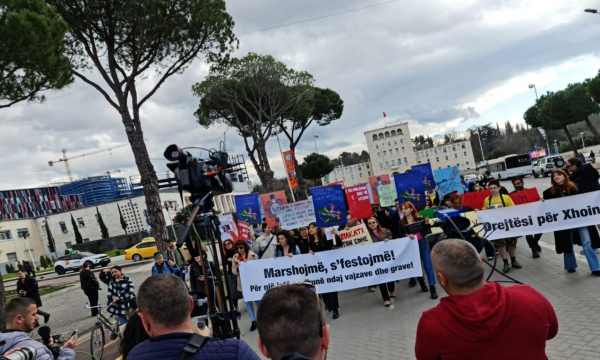
Participants of the Women’s Day march in Tirana, Albania, hold a banner that reads “we march, we don’t celebrate!” on Wednesday. Photo: BIRN/Fjori Sinoruka
In Bosnia and Herzegovina, marches were held in four cities – in the capital, Sarajevo, Tuzla, Banja Luka and Bihac.
Citizens in Sarajevo marched under the slogan “Determined girls will save the world”, protesting over the rising number of domestic violence and femicide cases in the country.
“We are determined to take power and save the world from the retrograde policies” was one of the messages sent from the protest.
In Montenegro, human rights groups and civic organizations on Wednesday called on the authorities to deal more firmly with domestic abuse and femicide, marching in the capital Podgorica under the slogan, “Resistance to force and injustice”.
According to the last police data, in February, 294 domestic violence cases were registered in 2021. Police reported that 1,774 cases were registered by misdemeanor courts.

People participate in a peaceful march on the occasion of International Women’s Day in Sarajevo, Bosnia and Herzegovina, March 8, 2023. Photo: EPA-EFE/FEHIM DEMIR
In Greece, March 8 this year has coincided with a 24-hour nationwide strike and mass protests over the deadly train crash on February 28, which claimed the lives of 57 people. People took to the streets in Athens, Thessaloniki, and other cities.
Feminist groups also participated in the strike and protests. The feminist collective “Sabbat” on social networks called for participation in the strike and protest, stating: “We declare that our voices will not be silenced until our lives come before their profits”.
Greek media outlet MIIR reported that Greece saw an increase in femicides in 2021, with a sharp rise of 187.5 per cent, from eight killings in 2020 to 23 in 2021.
In North Macedonia, the march took place on Wednesday under the slogan “Will women survive here?”
“Being a woman in Macedonia means waking up every morning in fear and wondering how and if you will survive that day,” the march’s announcement said.
As BIRN previously wrote, between 2018 and July 2022, there were 25 murders in the country in which the victims were women. The prosecution also keeps records of domestic violence homicide cases in which women were the victims – 18 over the same period. This suggests that of the 25 female murder victims, some 72 per cent died as a result of domestic violence.
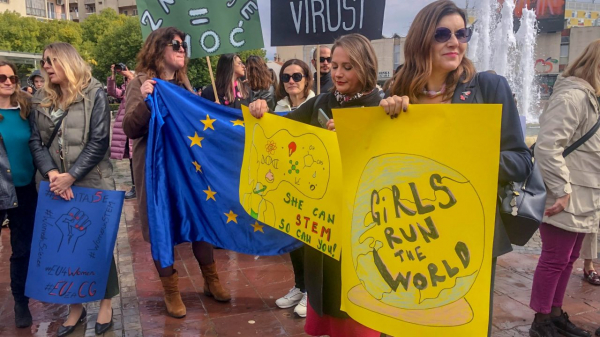
Participants hold banners and flags on International Women’s Day in a peaceful march in Podgorica, Montenegro. Photo: BIRN/Samir Kajosevic
In Croatia, a march also took place. Last year, 13 women were killed in the country. Statistical data also show that women in Croatia women do not have equal rights and opportunities in all areas of life.
In Bulgaria, March 8 was marked by a march on Wednesday evening in the capital, Sofia, against the lack of measures on domestic and gender-based violence, under the slogan “Not One More”. The march was expected to bring thousands onto the streets. So far in 2023, local media have reported five femicide cases.
“We march to celebrate the political, economic, cultural and scientific achievements of women but also to insist on our equal rights in all spheres of life,” the Bulgarian Fund for Women said.

Protesters carry placards and shout slogans during a nationwide 24-hour strike following a deadly train crash that claimed the lives of at least 57 people, in Mytilini, Lesvos Island, Greece. Photo: EPA-EFE/ELIAS MARCOU
A symbolic small-scale protest with the slogan “Not One More” was also held by Bulgarian women in Los Angeles.
The Sofia demonstration was likely also to target the political impasse in Bulgaria, which is holding up important law ratifications.
Earlier this year, amendments to the Law Against Domestic Violence were not accepted by parliament, and prompted the pro-Kremlin Bulgarian Socialist Party to launch a new campaign against “gender ideology” ahead of the April 2 elections.
In Serbia, the Informal Network of Feminist and Women Groups and Independent Activists organized a March 8 protest for women’s rights and for a living wage, called “DIGNITY. SALARY. LIFE!”
In just the first 64 days in 2023 in Serbia, nine women were killed; in the same period in 2022, two women were killed. Twenty-seven women were victims of femicide in 2022 overall.
In Turkey, the annual Feminist Night Walk was due to place on Wednesday in Istanbul and was expected to attract thousands of women. The walk will be the second one after Turkey exited the Istanbul Convention on women’s rights in 2021.
The Istanbul Governorate has banned the event and cancelled all bus and subway connections, blocking all roads and alleys to Istanbul’s iconic Istiklal Street, but women’s groups said they would march anyway, despite the risk of clashes with police, as there have been before at the women’s march in the past couple of years.
So far this year, at least 45 women have been killed by men in Turkey; 396 women were killed by men in 2022 and 427 in 2020.
In Moldova, the “Women for Women” organisation on Wednesday planned a solidarity march in the capital Chisinau dedicated to the women of Moldova and Ukraine, but also against the Russian military invasion of Ukraine. People shouted slogans against the war in Ukraine and against gender discrimination. “Peace and equality” was the slogan at this event.

Bulgarian women in Los Angeles express solidarity to the “Not One More” demonstration in Sofia. Photo by Feminist Mobilisations.
Source link: balkaninsight.com