Fjori SinorukaTiranaBIRNMarch 6, 202313:18After Friday’s court ruling failed to resolve who leads the biggest opposition party, both rival groups announced they will enter the next elections with their own candidates – deepening the divisions.
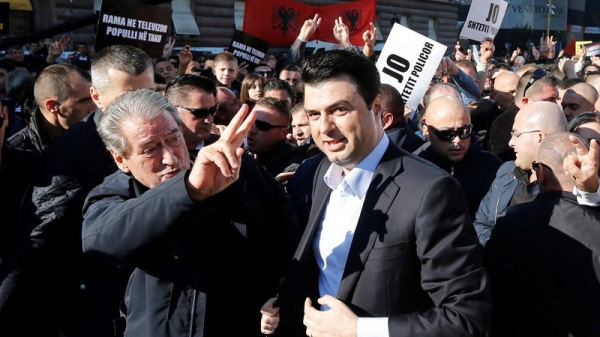
Albanian Democratic party Chairman Lulzim Basha (C) address supporters as former party leader and former Prime Minister Sali Berisha (L) looks on, Tirana, Albania, 22 November 2014. Photo: EPA/ARMANDO BABANI
After Albania’s Court of Appeals failed to end to the main opposition Democratic Party’s leadership battle, the rival two groups within the party on Monday both submitted their applications to the Central Elections Commission for the local elections on May 14.
On Friday, Tirana’s Court of Appeals accepted official leader Enkelejd Alibeaj’s request and ruled for a retrial in the longstanding case within the party against other group led by former leader Sali Berisha.
Berisha condemned the ruling, accusing Socialist Prime Minister Edi Rama of influencing it. “We will do everything for a big win in these elections,” Berisha said on Sunday.
On Sunday, the Berisha group officially requested that the Democratic Party be registered for the May local elections, insisting that “Sali Berisha is the only person who can submit candidates for mayors and municipal council candidates in the name of Democratic Party”.
On Monday, the Alibeaj group submitted exactly the same request, attaching a certification from the Tirana Court regarding the official party leadership.
Analyst and political journalist Lutfi Dervishi said that whatever happens, the opposition party is running only for second place. “Entering the election with two candidates means a battle for second place. And in the elections, there is no medal for the second place,” Dervishi told BIRN.
Afrim Krasniqi, a political expert who heads the Institute for Political Studies think tank, said elections are not a test for the personal careers of politicians, or a competition between rival factions in a party.
“Elections are held to provide alternatives and solutions for the citizens and the country. Albania … is tired of corruption and scandals … while there is a weak opposition, fragmented and unable to create a spirit of change and serious rivalry towards to the government,” Krasniqi told BIRN.
He said the opposition has failed to fulfill its mission. “The task of the opposition in a democracy is to keep the government under monitoring and offer a constructive alternative, in order to win a majority in the next elections.
“Today’s opposition has not understood its mission and role in this way. The number of citizens who are critical of the government and who demand qualitative change is much greater than the number of those who respond to the calls of the opposition factions and support it,” Krasniqi added.
“The agenda of the citizens, the agenda of the opposition and the personal agenda of the leaders of the two factions do not match, they are moving in opposite directions,” he continued.
The party has long been split between two factions, one centered around party founder and veteran political powerhouse Berisha, and the other, currently around Enklejd Alibeaj.
After the rival factions failed to reach an agreement between each other on who ran the party, a court ruling was the only way to put an end to the dispute.
Conflict in the party erupted last September when Lulzim Basha, then the party leader, expelled former PM and former president Berisha from the party’s parliamentary group.
This came after the US declared him “persona non-grata” for alleged involvement in “significant corruption”, “misappropriation of public funds” and interference in “public processes”.
Berisha then held several town hall meetings attacking Basha’s leadership. In December, he held a large-scale assembly at the Air Albania Stadium, where a new party statute was adopted.
Basha resigned last year after election defeats and delegated the party for one year to party parliamentary leader Alibeaj.
Alibeaj then appealed a court decision in March last year that recognized Berisha’s Assembly’s decisions.
In by-elections held earlier, Berisha’s “Freedom House” coalition did significantly better than the official party. Prime Minister Rama’s governing Socialists won five of the contested races, but the sixth, the important northern city of Shkodra, was won by Berisha’s candidate, Bardh Spahiu.
Source link: balkaninsight.com