Vuk TesijaZagrebBIRNMarch 2, 202318:12European Court rules that broadcaster was victim of ‘uneven justice’ by domestic courts handling its civil proceedings over ‘unjust enrichment’ – but its rights under the Human Rights Convention had not been violated.
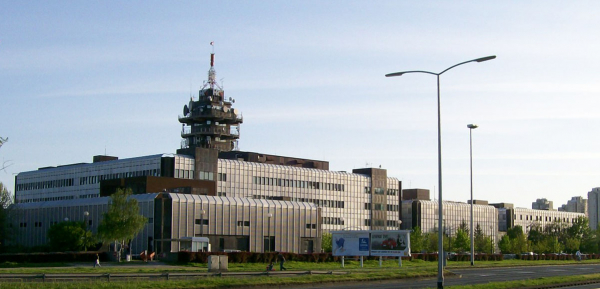
Croatian Radio and Television. Photo: HRT.
The European Court of Human Rights on Thursday dismissed as inadmissible Croatian Radio and Television’s case against what it called the divergent case law used by the domestic courts in their handling of its attempts in civil proceedings to claw back almost a million euros diverted by a rogue employee.
The court said HRT was a victim of uneven judicial practice by Croatian courts, but that its rights from the Convention for the Protection of Human Rights and Fundamental Freedoms had not been violated.
In October 2009, an internal audit discovered that A.K., an employee of HRT’s finance department, had paid fees for external translation services on behalf of the HRT to 176 individuals who had never performed those services.
The individuals had been contacted by A.K. directly or through an intermediary, a certain M.P., who was also an employee of HRT as a technician.
All payments had been processed through the systems of the institution and deposited in the accounts of the fictitious external contractors.
They then returned the sums paid to A.K. or M.P., keeping around 5 per cent of the sums as a commission. In that way, HRT lost around 7,500,000 Croatian kunas, or some 995,421 euros.
A.K. was dismissed and HRT lodged a criminal complaint against him. He died soon afterwards, in early 2010. No criminal proceedings were instituted against him.
In 2010 and 2011, HRT brought more than a hundred civil actions for enrichment without cause (“unjust enrichment”) against various individuals who had received the payments.
In about half of those cases, the domestic courts ruled in its favour, whereas in the other half, they ruled for the defendants, depending on which second-instance court had decided the case.
HRT submitted that all the cases examined on appeal by the Zagreb County Court or the Pula County Court had ended in those courts ruling against it.
The courts which ruled in favour of the HRT applied the general rule on unjust enrichment. They also held that there was no room for applying any exception because the defendants had received the funds in bad faith. Those courts considered it irrelevant whether A.K. had been authorised to act for and/or on behalf of the HRT.
The courts which found against the HRT applied the exception set. They held that A.K., in the eyes of the defendants, had had the authority to make the payments on behalf of HRT. Therefore, HRT had known or ought to have known that it had been paying something it had not been liable to pay.
HRT complained of the conflicting case-law of the domestic courts because in the 20 sets of civil proceedings in question, the courts had ruled against it, while in a number of other cases arising from the same set of facts they had ruled in its favour.
It also complained that, instead of harmonising the divergent case-law of the lower courts, the Supreme Court had itself become a source of uncertainty by dismissing HRT’s extraordinary appeals on points of law in those 20 sets of civil proceedings while allowing such appeals lodged in other similar cases.
HRT relied on Article 6 § 1 of the Convention that said: “In the determination of his civil rights and obligations everyone is entitled to a fair hearing by a tribunal”. But the court rejected the appeal.
Source link: balkaninsight.com