Vuk TesijaOsijekBIRNFebruary 28, 202317:52The Croatian culture institute Matica Hrvatska submitted a proposal to the government for a new law that would prevent the naming of streets and squares after figures from the Communist era and other totalitarian regimes.
This post is also available in this language: Shqip Bos/Hrv/Srp
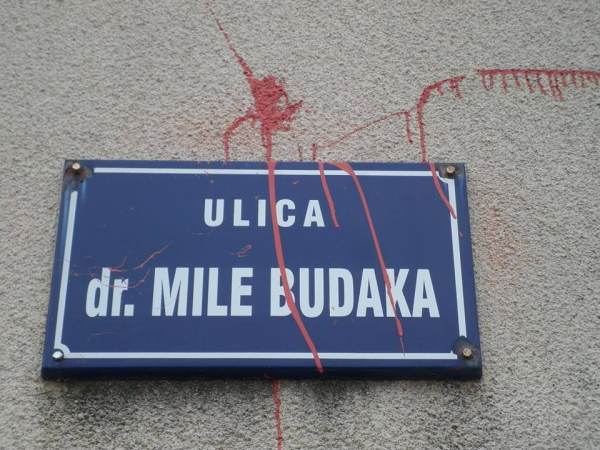
A street sign honouring WWII-era minister and author Mile Budak in Slavonski Brod. Photo: Wikimedia Commons/Andrija.
Matica Hrvatska submitted a proposal to the government on Tuesday calling for a new law to regulate the naming of streets and squares and prevent the honouring of figures from totalitarian regimes, particularly the Yugoslav Communist government.
The culture institute, which is Croatia’s oldest, argued that this would be in line with Council of Europe and European Parliament resolutions condemning the crimes of totalitarian governments.
“Both resolutions unequivocally equate and condemn European totalitarian regimes: Nazism, fascism and communism, and especially emphasise the alliance between Nazism and Bolshevism concluded on August 23, 1939, and the civilisational horrors of long-abiding communism,” it said in its letter to the government.
The letter argued that “there is no place for historical lies and relapses of the totalitarian past that return Croatia to the mire from which it emerged victorious in the Homeland War [for independence from Yugoslavia in 1991-95]”.
The proposal says that when evaluating which historical figures are suitable to name a street or square after, the rulings of Communist and socialist-era courts should not be authoritative, only the rulings of the courts in independent Croatia.
But Hrvoje Klasic, associate professor at the history department of the Faculty of Philosophy at Zagreb University, said he believes that “the motives behind this proposal by Matica Hrvatska are clear, it was prompted by the latest street name changes in Zagreb”.
Zagreb City Assembly was recently asked to change the names of four streets that honour Filip Lukas, Vladimir Ark, Antun Bonifacic and Archbishop Ivan Saric, all of whom were described by the World Jewish Congress “prominent collaborators” with the Nazi-allied, World War II-era Independent State of Croatia, NDH regime. Filip Lukas was Matica Hrvatska’s president from 1928 to 1945.
Klasic described Lukas as “a man whose views on racial politics and on relations with Jews and Serbs, but also with the Ustasa [right-wing extremist movement], are problematic to say the least”.
After Lukas escaped from Croatia in 1945, the Yugoslav Communist authorities sentenced him to death in absentia for supporting the Nazi-allied Independent State of Croatia, NDH regime.
However Lukas was rehabilitated in 2017 when Zagreb County Court annulled the Yugoslav-era verdict, which under Matica Hrvatska’s proposal would leave him eligible for honouring with a street name.
Klasic accused Matica Hrvatska of having double standards about right- and left-wing totalitarian regimes.
“I’m sorry that we still have that Croatian nationalism which is always kind of gloved and which doesn’t have the courage to say that, to some extent, it supports what was happening in the NDH,” he said.
“We are bearing witness to the fact that people who fight against totalitarianism are actually fighting against left-wing totalitarianism, and right-wing totalitarianism is not a big problem for them,” he added.
BIRN contacted Matica Hrvatska for clarifications about its initiative but was told that the questions would be forwarded to its presidency, which has its next session on March 7.
Matica Hrvatska was founded in 1842 with the purpose of promoting national and cultural identity in the areas of artistic, scientific and spiritual creativity, the economy and public life.
Source link: balkaninsight.com