Samir KajosevicPodgoricaBIRNFebruary 27, 202316:11Montenegro’s parliament finally appointed three new judges to the country’s Constitutional Court, which has been without a quorum since September last year.
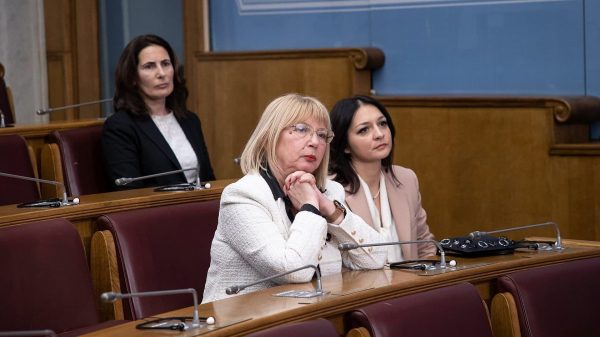
Montenegrin new Constitutional Court judges Momirka Tesic (L), Dragana Djuranovic (M) and Snezana Armenko (R) in the parliament. Photo: Parliament of Montenegro
Montenegro’s parliament on Monday appointed three new Constitutional Court judges and so opened a way to unblock the country’s highest legal instance, which has been without a quorum since last September. The court was left without a quorum on September 20, 2022, when Judge Miodrag Ilickovic followed three of his six colleagues in retiring.
Candidates Dragana Djuranovic, Snezana Armenko and Momirka Tesic were voted into their posts by 77 MPs in the 81-seat parliament.
A fourth candidate, Faruk Resulbegovic, failed to win support. The opposition Democratic Party of Socialists, DPS, Social Democrats and Bosniak Party did not support Resulbegovic, a national minority candidate. On February 7, Albanian coalitions and the country’s Bosniak party failed to agree on a joint minority candidate because Resulbegovic, a prosecutor from Ulcinj, was Albanian. Bosniaks wanted a Bosniak judge from Bijelo Polje, Alija Beganovic.
According to the constitution, judges need the votes of a two-thirds majority of MPs, or 54, with the bar falling to 48 MPs in a second-round vote. The three ruling blocs hold 41 of the 81 seats in parliament.
The head of parliament’s Constitutional Committee, Simonida Kordic, said that unblocking the Constitutional Court was an urgent necessity.
“Appointing Constitutional Court judges is a priority because the elementary democratic functioning of the state was called into question. We expect the candidates to be judges who will provide legal security and stability to the citizens of Montenegro,” Kordic said.
The court is the highest legal instance for appeals on electoral irregularities. Due to the lack of a quorum in the court, after the local elections last October, held in 14 municipalities, final electoral results couldn’t be confirmed in six towns, including the capital, Podgorica.
On July 27, 2022, parliament failed to elect new Constitutional Court members, as none of the 13 proposed candidates had the necessary support.
In October, opposition parties refused to vote for four proposed candidates, accusing the ruling majority of avoiding political dialogue. In November, opposition parties conditioned their support with the announcement of early elections.
Political parties have meanwhile misused the Constitutional Court blockage, trying to postpone the change of power in the capital, Podgorica, and the town of Pljevlja, with 21 appeals on the State Electoral Commission’s decision sent to the Court. On November 11, the head of Svetosavska lista Mirko Rmandic said he had appealed to the Court after Democratic Front leaders refused to apologize to him for accusations made during the electoral campaign.
The President of the European Council, Charles Michel, said that appointing the new judges was an important step towards a fully functioning judiciary in Montenegro.
But civic organizations warned that the court could be under political pressure. “We should ask ourselves, will the elected judges make decisions based on personal integrity or party dictates? I am afraid that judges close to political parties will be the majority,” the head of the watchdog NGO MANS, Vanja Calovic Markovic, told television Vijesti.
On January 18, Dragana Djuranovic, former protector of property and legal interests of the state, admitted she had been a DPS member since 2017. Parliament on Monday said she left the DPS before her appointment.
Media reported that Momirka Tesic, till now a Basic Court judge in Kotor, is close to ruling Democratic Montenegro. Former deputy ombudsperson Snezana Armenko has the support of the ruling Democratic Front. Tesic and Armenko denied claims of political links or bias.
In its latest progress report on Montenegro, the European Commission warned that while the Constitutional Court was unable to fulfil its role, due to the absence of a quorum, political uncertainty would worsen.
Source link: balkaninsight.com