Samir KajosevicPodgoricaBIRNFebruary 21, 202314:04Local authorities in the Montenegrin town of Rozaje called on the Serbian Orthodox Church to remove a fresco in the local church that depicts Bosniaks threatening a mother and baby with knives.
This post is also available in this language: Shqip Bos/Hrv/Srp
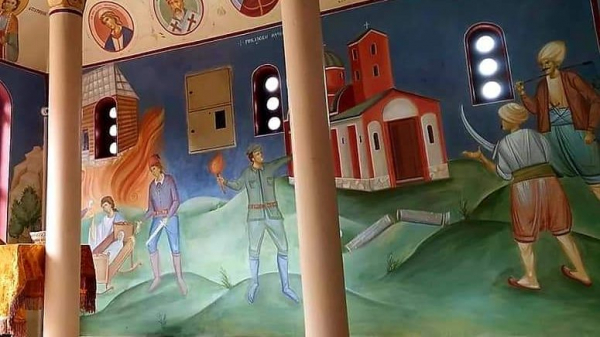
The fresco in the Ruzica Serbian Orthodox Church in the town of Rozaje, Montenegro. Photo: Twitter/Rifat Fejzic.
The authorities in the Montenegrin town of Rozaje said on Monday that they have urged the Serbian Orthodox Church to remove a fresco in the newly-renovated Ruzica church that depicts Bosniaks as violent, although the church claims it reflects historical reality.
“Religious temples should not have motifs that cause discontent among people. The fresco in the local church is not in accordance with our common social heritage and it’s not a reflection of religious beliefs that affirm respect among people in our town,” the mayor of Rozaje, Rahman Husovic, told media.
The row erupted on Sunday after media published photos of the fresco in the newly-renovated church in the town, which has a majority Bosniak population. The fresco shows two Bosniak men with knives trying to attack a mother with a baby.
It also depicts a man wearing a World War II Yugoslav Partisan uniform is depicted holding a torch next to a burning church, and two men in Ottoman Turkish clothing with swords preparing to attack the church.
The head of the Islamic Community in Montenegro, Rifat Fejzic, warned that the fresco is inciting ethnic divisions in the country, while the Podgorica-based Centre for Democratic Transition NGO called on prosecutors to launch an investigation.
Local authorities and Serbian Orthodox Church representatives agreed at a meeting on Monday to avoid any ethnic tensions in the town.
But local Serbian Orthodox Church priest Slobodan Radojevic said on Monday that the fresco presents historical facts and was not meant to incite divisions.
Radojevic stressed that war crimes against Serbs were committed in the Rozaje area during World War II, and that the church had been demolished twice in the past, by the Ottoman Turks and by the Yugoslav Communist authorities.
“With this display, we did not want to condemn individuals or any people, but we want to condemn the sin that someone committed. On the other side of the wall, to the right of the entrance, we showed the donors to this church, including Bosniaks who participated in the restoration of this church,” Radojevic told daily newspaper Vijesti.
“On one side we have those who demolished and killed and on the other side, those who built and prayed for peace. One scene is inseparable from the other and they should only be seen as a whole,” he added.
Built in the 17th Century, Ruzica is the only Orthodox church in Rozaje. It was demolished during Ottoman rule over northern Montenegro.
The church was rebuilt in 1924 but the Communist authorities demolished it in 1948 in order to build an elementary school.
The church was rebuilt in 1991 at another location and the frescos were painted in 2021 with donations from Serbian Orthodox Church believers and local Bosniaks.
Montenegro is a multi-ethnic state in which no community has an absolute majority. About 45 per cent of the population identify themselves as Montenegrin and about 29 per cent as Serb. The Serbian Orthodox Church is the largest religious community in the country.
Bosniaks make up roughly 8.3 per cent of the population, and mostly live in the northern towns of Rozaje, Pljevlja, Bijelo Polje, Petnjica, Plav and Gusinje.
Source link: balkaninsight.com