Perparim IsufiPristinaBIRNFebruary 16, 202316:27ECHR ruling says pardons issued by North Macedonia’s then President in 2016 – of Nikola Gruevski among others – have no bearing on trials of him and other high-level politicians.
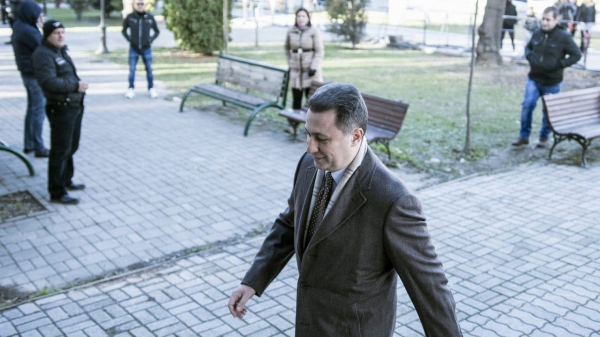
Former North Macedonia’s Prime Minister Nikola Gruevski arrives at a Skopje court for trial in December 2017. Photo: Robert Atanasovski
The European Court of Human Rights on Thursday ruled that pardons given in 2016 by North Macedonia’s then-President Gjorgje Ivanov cannot influence the trials held of high-level politicians from the country.
Eight North Macedonian citizens asked the ECHR to judge whether the decision to annul the pardons was unconstitutional.
The court ruled that the requests and complaints of convicted persons and defendants against such trials were inadmissible, giving domestic prosecutors and courts the right to try various political and security figures from the former ruling VMRO-DPMNE party, including its longtime leader, former Prime Minister Nikola Gruevski.
Former North Macedonian President Gjorge Ivanov, a close ally Gruevski, gave him and dozens of others pardons in 2016.
Other names pardoned by Ivanov include Sasho Mijalkov, former director of the Bureau for Security and Counterintelligence, Gordana Jankulovska, former Interior Minister, Mile Janakieski, former Minister of Transport, and others.
“The Court held that the applicants had failed to exhaust domestic remedies. It held that the complaints… were premature as the domestic authorities would have an opportunity to address them first in the pending criminal proceedings,” the ECHR said in a press release.
In 2015 in North Macedonia, several covert recordings of telephone conversations of VMRO-DPMNE senior figures were published by the Social Democrats, then in opposition.
Files stemming from these recordings were later given to prosecutors. As a result, they became suspects for various crimes, including electoral offences.
In March 2016, the Constitutional Court annulled the 2009 Pardon Act, holding that it was unconstitutional, but one month later Ivanov issued 51 individual pardons exempting 56 people, including the applicants, from criminal prosecution in relation to the specific offences identified.
Massive street protests – known as the Colourful Revolution– sprang up in response, which included the President’s office being attacked.
“Following a change in the law, in May and June 2016 the President annulled the pardons he had given. As a result, trials were started or continued against the applicants for the alleged offences. The trial court confirmed that the pardons no longer had legal effect and that therefore indictments against the applicants were legal,” the ECHR ruling said.
Gruevski stepped down as PM in January 2016 and resigned as VMRO DPMNE party leader the following year. That year, the Social Democrats under Zoran Zaev took over the government.
In 2018 absconding to Hungary, he was sentenced in absentia to two years in prison for the illicit purchase of a luxury vehicle and another seven years for money laundering after. He subsequently received asylum from Viktor Orban’s government and has refused to return home to do his sentence.
Since then, he has avoided publicity and little is known about his activities. But he made headlines last summer when he established I.C.I.C Ltd, a small company in a village on the outskirts of Budapest. The company is registered in a deserted house with no sign of activity, with Gruevski listed as the sole owner and chief executive.
Source link: balkaninsight.com