Hamdi Firat BuyukSarajevoBIRNFebruary 9, 202316:08As Balkan countries join many others in helping Turkey via the EU Civil Protection Mechanism and other channels, devastated northern Syria seems to have been left out of the calculations.
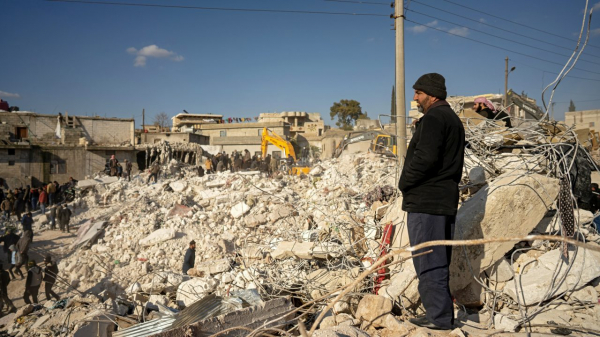
A man watches as rescuers and volunteers search for survivors under the rubble in Harim, near Idlib, Syria February 8, 2023. Photo: EPA-EFE/KARAM AL-MASRI
While the EU, US and European countries rush to help Turkey following two major earthquakes registering 7.9 and 7.7 on the Richter scale, northern Syria, which was also badly hit, appears to have been left out in the cold.
More than 16,000 people in Turkey lost their lives in the quakes on Monday and nearly 63,000 were injured. The death toll in neighbouring Syria, stood at least at 3,900 on Thursday.
The European Union’s disaster agency, European Civil Protection and Humanitarian Aid Operations, announced that 20 EU member states as well as the Balkan countries of Albania, Montenegro and Serbia had offered help to Turkey under the EU Civil Protection Mechanism.
“With 31 search and rescue teams and five medical teams via the EU Civil Protection Mechanism, the teams consist in total of over 1,500 rescuers and 100 search and rescue dogs,” European Civil Protection and Humanitarian Aid Operations said, announcing an initial 3 million euros in emergency assistance.
Other Balkan countries including Bosnia and Herzegovina, North Macedonia and Kosovo have also joined the help for Turkey, sending rescuers and aid.
But while Syrian authorities on Wednesday asked the EU to activate the EU Civil Protection Mechanism and as the EU announced 3.5 million euros of assistance, it is not clear how and when help will arrive in Syria.
BIRN did not get an answer from the European Civil Protection and Humanitarian Aid Operations by time of publication.
Bosnia, Montenegro, Croatia, Serbia and Bulgaria as well as several Balkan NGOs have mentioned sending help to Syria but details of the help are not known.
Romanian Foreign Minister Bogdan Aurescu stated that Romania is ready to help Syria with equipment and medicine and is looking for logistical means to transport them to the country.
“We have approached the Syrian authorities to provide us with a list of equipment and concrete needs for humanitarian aid. I have forwarded this list to colleagues at the Ministry of the Interior and the Ministry of Health. Furthermore, in cooperation with our institutional partners, we are trying to identify transport methods for these aids,” Aurescu told a government meeting on Wednesday.
The Polish government and NGOs have mentioned Turkey and Syria at the same time but details of potential help for Syria are not known. A Catholic charity in Poland, Help the Church in Need, is collecting funds specifically for Syria.
Greece, which has sent hundreds of rescuers and firefighters to Turkey, also promises support for Syria. A Greek rescue mission will soon travel to Syria after it activated its request to the European Civil Protection Mechanism.
Athens Macedonia News agency reports that the aid includes tents, medicines and other supplies for people who are homeless and need immediate support.
“This earthquake has not just affected Turkey, it has also affected Syria. There, the situation is even more complicated because essentially there is no official interlocutor. So we have to work through international organizations,” Greek Prime Minister Kyriakos Mitsotakis said in an interview with CNN.
The first convoy of UN aid for opposition-held north-west Syria has reportedly crossed into the area from Turkey. War between the Syrian government and the opposition forces still continues in the area. Even before the earthquake struck, 4.1 million people in the area – most of them women and children – were relying on humanitarian assistance.
According to media reports, search and rescue missions in the area are very limited and authorities urgently need rescue teams, shelter and medicine.
The only way into the area is via the Bab al-Hawa crossing in Idlib with Turkey, but nearby motorways and airports have been devastated in Turkey making delivery of assistance to Syria even harder.
Source link: balkaninsight.com