BIRNAthensBIRNJanuary 19, 202315:57An ethnic minority party in Greece has written to the UN documenting the problems faced by the Turkish minority living in Western Thrace.
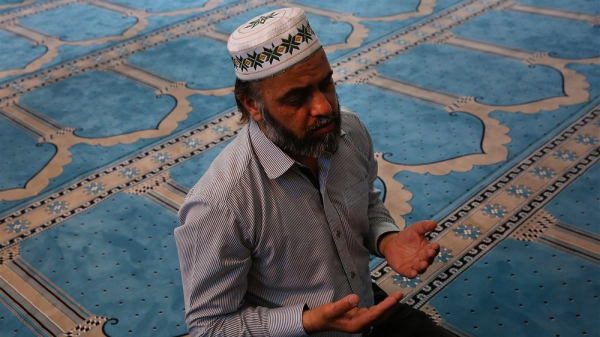
A Muslim in Athens praying in a new mosque, the first official place of worship for Muslims in Athens, 2019. Photo: EPA-EFE/ORESTI PANAGIOTOU
The Friendship, Equality and Peace Party, (Dostluk Eşitlik Barış Partisi), DEB, has written to the UN Special Rapporteur on Minority Issues calling attention to the problems faced by ethnic minorities in Greece – especially the unrecognised Turkish minority in Western Thrace.
The letter focuses on its educational and religious problems and its legal harassment for use of the word “Turkish”.
Greece does not recognise the existence of a Turkish community in Thrace, only a “Muslim” minority alongside Pomaks (Bulgarian-speaking Muslims) and Muslim Roma.
Regarding educational issues, the party claims there is state interference in the education system, and that over the last 20 years, more than 100 minority schools have been closed.
The party also refers to the legal right of the minority to choose its own religious leaders, or Muftis. Today there are three Muftis, one in Xanthi, one in Komotini, and one in Didymoteixo, northern Greece, chosen by the Greek government; and two Muftis, one in Xanthi and Komotini, elected by the minority.
The DEB also says associations with the word “Turkish” in them have been closed, violating their right to freedom of organization and assembly.
A ruling of the European Court of Human Rights on the return of legal status to Turkish associations and unions has not been enforced since it was adopted in 2008, it notes.
Four unions that were either dissolved by the authorities or never registered won cases before the European Court for Human Rights, citing the European Convention on Human Rights and the Greek constitution.
The DEB highlights that its president Çiğdem Asafoğlu became a target of the Greek media when she openly expressed her Turkish identity in a TV interview after winning a seat in the European Parliament elections in 2019, while highlighting that other prominent figures from the minority have also faced serious threats.
Konstantinos Tsitselikis, professor at the University of Macedonia in the department of Balkan, Slavic, and Oriental Studies, said some of the complaints are fairer than others.
Tsitselikis mentioned that logically some schools in Thrace been closed as the minority is shrinking in size, and, based on the law, schools cannot operate with a small number of pupils.
Tsitselikis also pointed out that Muftis should be elected, and appointed, by the community, which is another problem. Those currently selected by the minority “are not directly elected. There is a political issue as the Turkish consulate influence the minority”, he said.
On the other hand, he condemned Greece for not recognising Turkish associations. “It is extreme behaviour by the Greek courts, which do not recognize unions that are completely legal just because the name ‘Turkish’ is mentioned in their title,” Tsitselikis stressed.
A huge population exchange between Greece and Turkey in the 1920s resulted in the creation of an almost ethnically pure Greek state. However, Western Thrace was exempted from its provisions, which is why a significant minority exists there today.
Source link: balkaninsight.com