Svetoslav TodorovSofiaDecember 13, 202211:34The GERB party proposed a new cabinet with a fresh face as designated prime minister instead of leader Boyko Borissov in a bid to end the country’s political deadlock, but opposition parties remain unconvinced.
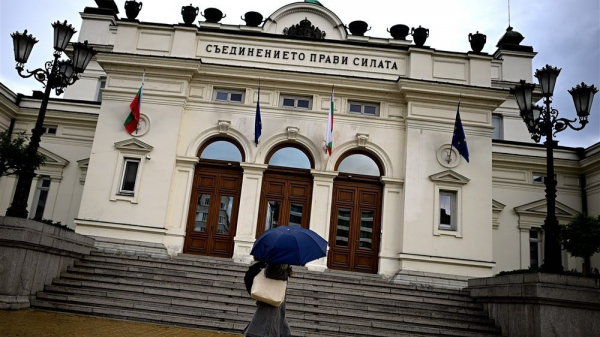
The parliament building in Sofia, Bulgaria, October 2022. Photo: EPA-EFE/VASSIL DONEV
Bulgaria’s parliament will decide later this week on election winners GERB’s proposed cabinet, but the vote is not expected to end the country’s grinding stalemate.
The coalition partners in the country’s 2021-22 government, We Continue the Change, Democratic Bulgaria and Bulgarian Socialist Party, have said that they won’t back the cabinet.
“This projected government is nothing more than a cover-up for [GERB leader Boyko] Borissov, [President] Radev and [oligarch and Movement for Rights and Freedoms MP] Delyan Peevski,” ex-Prime Minister Kiril Petkov of We Continue the Change told local media on Monday.
Far-righters Revival are also expected to vote against, while Bulgarian Rise, the newest party in the parliament, remains ambiguous.
The Movement for Rights and Freedoms, a party associated with oligarch ties and with Peevski, an internationally sanctioned politician, remains GERB’s only ally, but its support won’t secure a majority for the proposed cabinet.
On Monday, GERB’s proposed premier, political newcomer Nickolay Gabrovsky, announced a proposed cabinet dominated by non-party names.
The proposed cabinet is being promoted by GERB as a cabinet of experts who are not members of the party – a move intended to attract the trust of the opposition, with controversial party leader Boyko Borissov temporarily moving out away from centre stage.
Some of the names have associations with the political scene of the 2000s and seem eager for a comeback, while others were previously opponents of Borissov’s rule.
Examples include the proposed minister of tourism, former socialist and former Playboy publisher Martin Zakhariev and proposed minister of transport Proshko Proshkov, once a critic of GERB.
Deputy minister of regional development and waters would be Meglena Plugchieva, who was deputy premier to socialist Sergey Stanishev in 2005-2009, when the ruling coalition featured Bulgarian Socialist Party, Movement for Rights and Freedoms and NDSV.
The proposed interior minister is ex-NATO envoy Dragomir Zakov, who paradoxically was defence minister in Kiril Petkov’s cabinet, which GERB helped to oust.
The proposed cabinet will be voted on by parliament by the end of the week. The voting process delays the greenlighting of the 2023 state budget, a topic of tense discussions for MPs.
If GERB fails, the mandate will go to Petkov’s We Continue the Change.
As with GERB, We Continue the Change has only one clear ally, Democratic Bulgaria, foreign policy differences have created further divisions between Petkov’s party and the pro-Moscow Socialist Party.
If Petkov decides to form a minority cabinet, that is also likely to fail, meaning that Bulgaria’s continuing political crisis is likely to continue in 2023 with new elections in the spring.
Bulgaria had three election winners in 2021 – GERB, There’s Such a People and We Continue the Change, the latter forming a short-lived reformist government, critical of Borissov’s autocratic legacy.
GERB made a comeback this October in polls that saw a record low voter turnout.
Source link: balkaninsight.com