Nicholas WatsonPragueBIRNApril 25, 202311:23The EU’s proposed Media Freedom Act can’t come soon enough if two new reports on press freedom are to be believed.
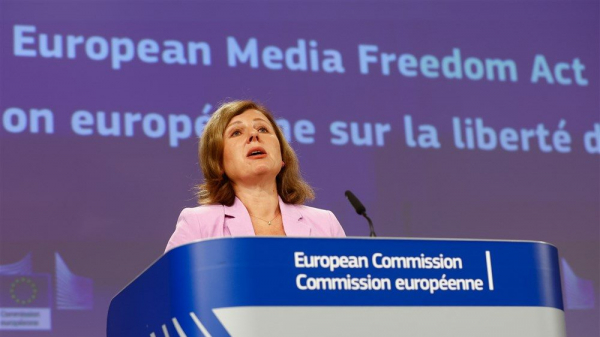
European Commissioner for Values and Transparency Vera Jourova gives a press conference on the Media Freedom Act at the European Commission in Brussels, Belgium, 16 September 2022. EPA-EFE/STEPHANIE LECOCQ
Media freedom is under the spotlight again this week as two new reports show public concerns about the issue have risen significantly, alongside increasing media ownership concentration and worsening conditions for journalists doing their job in Central and Southeast Europe.
The reports will feed into the ongoing legislative process of the EU’s proposed European Media Freedom Act (MFA), which is at an advanced stage with civil society groups submitting their positions as part of a public consultation by the European Commission. The MFA is a key piece of legislation from the EU Commission to address serious threats to media freedom and pluralism across the bloc.
The Committee for Editorial Independence published on Monday a new survey examining the state of media freedom in the Czech Republic, Hungary, Poland and Slovakia, which showed that more than 50 per cent of those surveyed in each of the countries expressed growing concern about the current state of media freedom.
Slovakia and Poland recorded the worst rises, with 71 per cent of respondents in Poland expressing concern, up 8 per cent from last year.
The negative impacts of media owners and governments influencing journalistic content have become more apparent to the public, the survey found. In Poland and Hungary, it is the government that is perceived as the biggest threat to media freedom; in the Czech Republic and Slovakia, it is media owners and business interests that are seen as the primary threat.
“The survey indicates that people are in favour of the state strengthening legislation to safeguard media freedom and independence. They also support the European Union imposing penalties or sanctions on governments that interfere with media freedom,” the report said.
Monday also saw the publication of the “Media Freedom Report 2023”, the second annual report on media freedom in the EU produced by the Civil Liberties Union for Europe.
Likewise, this report found that in the 18 countries surveyed there was no progress on media freedom in general, while the situation has even worsened in some of the countries, including Bulgaria, Croatia, Czech Republic, Hungary, Poland, Romania, Slovakia and Slovenia.
The report focused on three aspects: media freedom and pluralism, safety and protection of journalists, and freedom of expression and information.
Strong media ownership concentration persists and poses a significant risk to media pluralism in Croatia, Czech Republic, France, Hungary, Italy, Poland and Slovenia. “Having a small number of companies or individuals own a majority of the media threatens the diversity of media voices and creates a potential for biased reporting,” it said.
Financing frameworks also remain problematic, with many outlets struggling financially. The report put this down partly to the difficult business environment, but also the unfair and obscure allocation of state advertising and subsidies, particularly in Hungary and Poland.
It also found those two countries guilty of exerting too much state control over the public service media as well as the media regulatory authorities.
In many countries, the report found it is becoming increasingly difficult for journalists to do their job, with harassment, physical and verbal attacks, surveillance, and abusive lawsuits – so-called strategic lawsuits against public participation (SLAPPs) – becoming increasingly common. “Safeguards to protect journalists and their sources from state surveillance are insufficient and women continue to be paid less than their male colleagues and are more likely to be harassed and threatened, particularly online,” it said.
“For the functioning of a healthy democracy, it is crucial that the public has access to and trusts reliable and credible sources of information. However, public trust levels towards the media remain particularly low in Croatia, Slovakia and Slovenia,” it added.
Source link: balkaninsight.com